
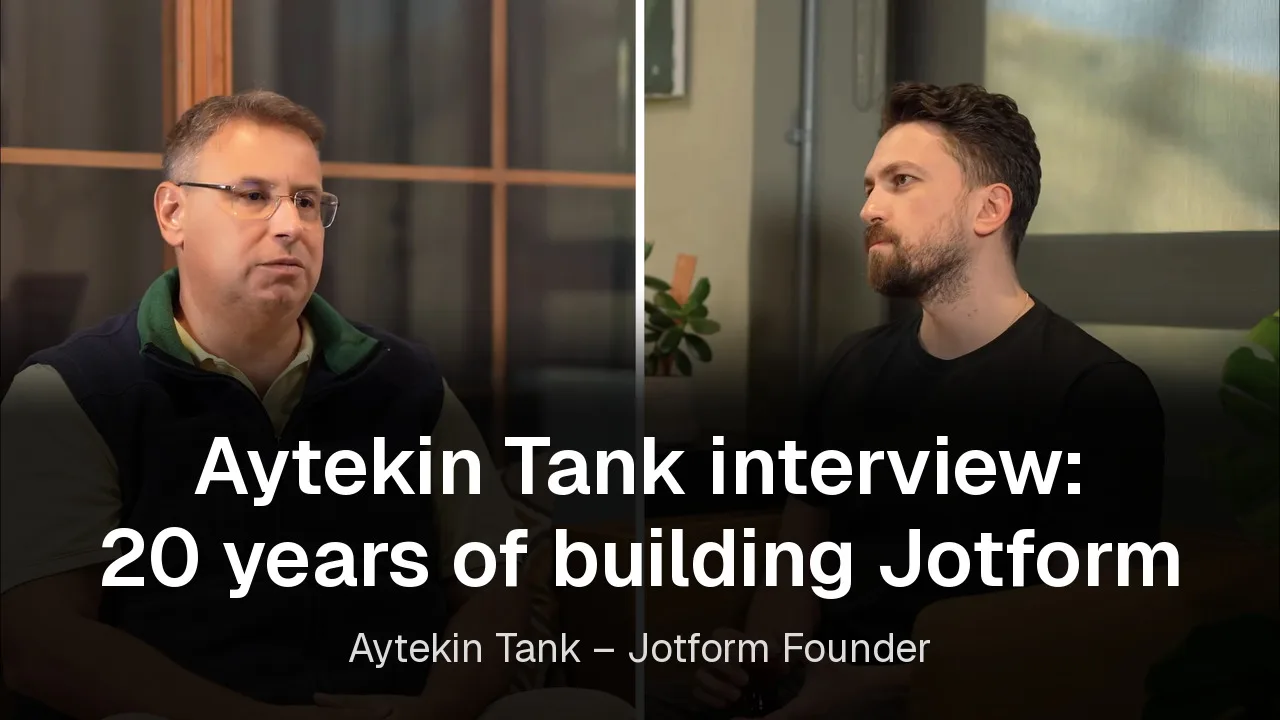
Aytekin Tank interview: 20 years of building Jotform
Aytekin Tank left his job in 2005 to build Jotform. He tells Emre Elbeyoglu about the free first year, small teams, the pandemic jump and stepping back for AI.
Published 22 min read

Founder, GrowthMarketing.ai
15+ years of experience
Emre Elbeyoglu is a B2B SaaS growth expert and Founder of GrowthMarketing.ai. With 15+ years of SEO and GEO experience, he studies search and AI ranking systems to support growth work for brands including Rakuten and Investing.com. He has also bootstrapped SaaS products including Popupsmart and LiveChatAI.
- Computer Technology & Information Systems, Bilkent University
- Co-founder & Growth Lead, Popupsmart (since 2019)
- Co-founder, LiveChatAI (since 2023)
Share article
Explore with AI
Aytekin Tank is the founder of Jotform, the online form builder he started in 2005 after years of coding forms by hand in New York. The first version shipped in February 2006 and stayed free for more than a year. Jotform now has about 800 employees, most of them in Ankara, and more than 30 million users.
Watch the full 59-minute interview above (English dub), or the 17-minute part on how Jotform was built under the next heading.
Video summary and key insights
Aytekin Tank has run Jotform for 20 years. I'm Emre Elbeyoglu, founder and CEO of SEOmator, and Aytekin Tank has been my mentor for more than two years. In this interview, Aytekin Tank tells Jotform's story in his own words: the forms he hated building, the free first year, the slow early growth, what broke at 15 people, the pandemic jump, and why he handed day-to-day operations to his COO in 2023. Two more parts of the interview, on building a global SaaS from Ankara and on staying focused on one product, are included below. Most of it comes back to patience: Jotform stayed a small company for its first ten years.
- Jotform started with a hated task. Aytekin Tank built forms for well over 100 websites at a New York internet company and decided to build the tool he wished existed.
- It was free for over a year. From February 2006 to March 2007, so the product could prove itself before anyone paid.
Making something you hate easier, making a task you dislike much simpler. In other words, killing a pain point. It's really about eliminating pain. And that's what I tried to do.
- 500 of the first 15,000 users paid. That was the first premium plan, in 2007.
- Growth broke at 15 people. Separate, isolated jobs made the work worse; small cross-functional teams of five or six fixed it.
- The pandemic was a jump, not a new slope. The world went digital in a hurry; Jotform's growth jumped, but that exceptional pace didn't continue.
- Aytekin Tank stepped back in 2023. The COO runs operations; he works on one or two projects, almost all AI.
- Ankara is a hiring advantage. People stay at Jotform for five to fifteen years.
- Focus compounds. Every Jotform product is a feature of one platform, and switching products resets the clock.
The issue is, around 15 people, everyone develops these silos of expertise. When we were just a five or six person company, we worked on one single thing, all of us together.
I opened by asking for the milestones of Jotform's 20 years, from New York to the AI agent era. The pages that rank for Aytekin Tank's name are his own profiles and column archives, and they repeat the same one-line bio; only his about page sketches the origin, in a few sentences. Aytekin Tank's answers cover the dates, figures and decisions behind it, and the interview's other parts go deeper on Jotform's AI software factories and on whether AI will replace software engineers.

Who is Aytekin Tank?
Aytekin Tank is the founder and CEO of Jotform, the online form builder, and the author of Automate Your Busywork. When we analyzed the nine profiles we could read on November 19, 2026, seven used both titles, founder and CEO, all nine mentioned his book, and most added that he writes regular columns on productivity and automation.
His own about page puts it in one line: "I'm Aytekin Tank, founder and CEO of Jotform, host of the AI Agents Podcast, bestselling author, and automation enthusiast." Wiley published Automate Your Busywork in May 2023, and he writes for Fast Company, Entrepreneur and Forbes, whose contributor bio calls Jotform "a bootstrapped global SaaS company."
The profiles mostly skip how he got there. Before Jotform, Aytekin Tank was a developer at an internet company in New York for five years. He grew Jotform from a one-person project into a company of about 800 people, most of them in Turkey, and in this interview he describes a role that has changed since 2023: the COO runs day-to-day operations, and Aytekin Tank works on a few projects, almost all of them in AI. I also hosted his earlier talk on how to build a great AI product.
How did Jotform start?
Jotform started because Aytekin Tank hated building forms. As a developer at a New York internet company with well over 100 websites, he built contact and payment forms over and over, couldn't find a product that did it well, and decided to build one himself.
Before starting Jotform, I was working as a developer at an internet company in New York. I worked there for five years. During that time, we had well over 100 websites and I was constantly building forms. I hated forms at that point.
Aytekin Tank left his job in 2005, and in his telling the first year was the fun phase. He worked alone: he lived in Brooklyn, took his laptop to a café every morning and wrote code. He calls it "very bohemian" (at 01:28 in the video) and says his savings from working in the US meant that even a failure would have been a learning experience.
Café work got old, though, and he wanted an office and employees. The move to Ankara came next: he opened Jotform's first office at Hacettepe Teknokent and hired his first employee. Growth was slow: one employee the first year, a second the next, and about five years to reach five people. He says SaaS starts slowly by nature, but with low churn it snowballs.
Jotform was free first, paid later, and that was on purpose:
I released the first version of Jotform in February 2006, totally free. Until March 2007, over a year, Jotform was entirely free. The goal there was basically: let the product prove itself, let people use it and get feedback from them.
By the end of that first year, Jotform had 15,000 registered users. When the first premium plan launched, 500 of them upgraded, which Aytekin Tank read as proof that a good share were using the product in earnest. Evren Bayraktar, Jotform's VP of Growth, told the later part of this story in Jotform's growth story.
Put in order, the milestones look like this:
| When | Milestone |
|---|---|
| Early 2000s | Developer at a New York internet company for five years, building forms for 100+ websites |
| 2005 | Leaves his job; codes Jotform alone in Brooklyn cafés for a year |
| February 2006 | First version of Jotform, free |
| After the solo year | Moves to Ankara, opens the first office at Hacettepe Teknokent, hires the first employee |
| March 2007 | First paid plan: 500 of 15,000 registered users upgrade |
| About 2014 | Jotform reaches 15 employees |
| About 2016 | Jotform version 3 launches |
| The pandemic | Biggest growth spurt; headcount grows by about 100 a year for a while |
| 2023 | Aytekin Tank hands day-to-day operations to the COO |
| 2026 | About 800 employees; about 35 million users by his estimate |

What four metrics does Aytekin Tank ask founders for?
Aytekin Tank asks every founder he talks to for four numbers: monthly traffic, signups, active users and paid users. Most of the time, he says, they aren't tracking them (at 03:39).
Active users matter most to him, because feedback comes from the people using the product. A founder who knows how much they raised but not how many active users they have can't tell whether the product works. He wants all four on a chart, month by month.
What broke when Jotform reached 15 people?
At about 15 people, Jotform's work got worse because everyone had separate, isolated jobs, Aytekin Tank says. He had copied the structure of his old employer, assuming that's how bigger companies worked, and the result was "really weak work."
Two things went wrong at once. Aytekin Tank was spending his days on support, accounting, purchasing and kitchen supplies, so he started handing tasks to people. Each person then built a silo. The early team of five or six used to eat lunch together and argue about the product all day; at 15, nobody shared a goal.
The fix came from Eric Ries. Aytekin Tank had been reading Eric Ries's blog, before or around the time of The Lean Startup, and took the idea of small cross-functional teams. When Jotform moved into bigger offices at Hacettepe, he split the company into teams of five or six that each run "independently like their own startup" (at 07:00). He was trying to recreate the original five-person company inside every team.
Each team also got its own designer. Designs still didn't ship, because developers waved them off, so Jotform invented what it calls the UI developer: a developer who only writes CSS and works next to the designer. Aytekin Tank says the work got "vastly better" after that, and Jotform version 3 followed around 2016.

The small-team structure is still how Jotform works, and Aytekin Tank says it survived the AI era for the same reason it was created: a team of five or six brings different disciplines to one problem.
How did the pandemic change Jotform's growth?
The pandemic gave Jotform its biggest growth spurt, because the world digitized years of paperwork almost overnight, Aytekin Tank says. But it was a one-time jump: growth stepped up, and that exceptional pace didn't continue.
Jotform's growth was always tied to digital transformation, in his telling. When he started in Ankara, many people in Turkey didn't know what "form" meant and wrote formal petitions instead; even in the US, people printed forms, faxed them and emailed them back.
All of a sudden, the world leaped forward 10 years. Actually, that's what happened in the pandemic.
During the pandemic, Jotform's data team kept asking whether growth would fall back once it ended. It didn't fall back. It didn't keep climbing at the new rate either: people who moved to online forms and online signatures stayed, so the jump held without turning into a steeper line. Headcount followed: about 100 new people a year for a while, then a slowdown. "Right now, we don't really need to grow that much anyway," Aytekin Tank said (at 17:01).

As for the numbers today, Aytekin Tank said Jotform "should be" at about 35 million users, adding that he hadn't checked the latest numbers, and confirmed about 800 employees. His own site says "over 30 million users," and his November 2026 Forbes column describes "an 800-person company," so the headcount matches and the user count is his estimate.
Why did Aytekin Tank step back from running Jotform?
Aytekin Tank stepped back because running a large company pulled him away from the product: his days filled with meetings about office interiors, architecture and HR. After a first attempt that didn't hold, he handed day-to-day operations to Jotform's COO in 2023.
So in 2023, this time, I completely pulled the plug and told the COO: I am totally stepping back. Right now I'm only dealing with one or two things, working on one or two projects. I don't even meet with the VPs anymore.
He described it as the same trap as at 15 people, one level up. Both attempts lined up with the births of his children, when he was away for about three months; the second came with his third child, in 2023, and it stuck. His public profiles still call him CEO; this is his own account of how he spends his time, not a title change.

His work now is almost entirely AI. On the day of the interview he had seven or eight meetings with teams before arriving, reviewing what they had built, and the day before he had recorded a podcast episode on AI factories.
Aytekin Tank's way of keeping up is learning by teaching. He co-hosts the AI Agents Podcast, which Jotform started partly for marketing and which he now treats as a way to learn: preparing a 45-minute episode on AI factories meant going through examples, reading articles and watching videos on the topic. At Jotform's Friday demo days, where teams show what they built, he talks for five or ten minutes on a topic he wants to learn himself. "Right now, I'm trying to teach things so I can learn them myself," he said (at 12:33).
Why build a global SaaS from Ankara instead of Silicon Valley?
Aytekin Tank's main reason for Ankara is retention: people stay at Jotform for five, ten or fifteen years, while in Silicon Valley he'd compete with Google, OpenAI and Anthropic for every engineer. Turkey's old cost advantage is gone, he says, but technopark tax benefits remain.
Cost used to be part of the case. In Jotform's early years, Turkish technoparks offered tax advantages and much lower costs, so a young company could hire five people instead of three. That cost gap has been gone for three to five years, he says, because Turkey became expensive and salaries rose toward US and European levels. The technopark tax advantages continue.
Talent is the part that still holds. In Silicon Valley, Jotform would hire against Google and Meta, and now OpenAI and Anthropic. Jotform has an office in San Francisco for its marketing team and one technical team in Vancouver, but the product is built in Turkey, with offices in Ankara, Izmir and Istanbul and most people in Ankara.
Employees really stay for a very long time. They work at Jotform for five, ten, fifteen years. That's really tough in Silicon Valley. Someone joins and before you know it, Google's poached them. They leave after six months.
The downside is distance. On a recent trip to the US, Aytekin Tank was struck by self-driving cars and delivery robots, and he says following AI from Turkey takes deliberate effort. That's part of why he does podcasts.
As for why Turkey has few big B2B SaaS companies, Aytekin Tank's answer starts with language: a product built only for Turkey targets about 1% of the world, so it has to sell in English, and broken English on a website kills trust. He thinks AI writing the copy has mostly removed that barrier. That leaves the part that is hard anywhere: finding the right idea and carrying it through. Beyond that, he said, he doesn't know why more of them haven't grown big.
Why has Jotform stayed with one platform for 20 years?
Aytekin Tank has kept Jotform on one platform because focus compounds: every year on the same product builds on the last, while switching to a new product starts the clock from zero. He calls losing focus the biggest mistake he sees founders make.
I raised it because Aytekin Tank had once criticized me for spreading my focus over too many areas. Aytekin Tank admitted he did the same at first: early on he took custom work for other clients to pay salaries while Jotform's revenue was low, and later cut it out completely.
Every product is a feature, in Aytekin Tank's view. Jotform has built many products in 20 years, among them Jotform Sign, workflows, an app builder and a PDF editor, but each one serves the next step of a form user's journey. "All of those products are actually features of Jotform in a way," he said.
Aytekin Tank pictures Jotform as the castle with one main gate, with a moat around it. Most people come in through the biggest gate, forms, and the goal is to get them using the other products too, because the more products they use, the longer they stay inside.
To explain compound returns, he used investing as the analogy. Put the same amount in every month, and for years it looks like nothing is happening; most of the result arrives in the final years. A founder who switches products after two years gives up everything learned from users and starts from zero. Split the effort across two products, and twenty years might become forty. Jotform itself, he said, was "this tiny company struggling along" until about year ten.
So even if it's not working, maybe you can pivot to the same customer segment with what you learned there. It's called a pivot for a reason. You've got to keep one foot planted.
I've written about learning this the hard way, in the feature creep lesson from Popupsmart v2, and about a bootstrapped RegTech founder who chose to focus on his home market in Efilli's bootstrapped SaaS story.
What else did the interview cover?
The interview's other parts go deeper on AI at Jotform. Each is its own post with its own video:
- What is a software factory? Inside Jotform's AI version: how Jotform's bug-fix factory takes a bug from report to fix to reply, and Aytekin Tank's three rules for any AI factory.
- Will AI replace software engineers? Jotform's CEO answers: why Jotform's developers got about ten times faster and nobody was laid off.
- How to build a great AI product: Aytekin Tank's earlier talk on building Jotform's AI support agent.
Jotform's VP of Growth, Evren Bayraktar, covers the growth team's side in an earlier two-part interview with me: Jotform's SEO and AI search strategy and Jotform's AI adoption strategy.
Frequently asked questions
Who is the owner of Jotform?
Jotform was founded by Aytekin Tank, who started building it in 2005 and released its first version in February 2006. His own about page and most profiles we read call him Jotform's founder and CEO, and his Forbes contributor bio and Amazon author page describe Jotform as a bootstrapped company. None of the pages we read gives an ownership breakdown, so we don't state one. In this interview, Aytekin Tank said that since 2023 Jotform's COO runs day-to-day operations while he works on a few projects, almost all of them in AI.
When was Jotform founded?
Aytekin Tank left his job and started working on Jotform in 2005, and he released the first version in February 2006. His LinkedIn profile and his own about page date Jotform's founding to 2006, the year the product launched. He spent the first year coding alone in cafés in Brooklyn, New York, then moved to Ankara, where he opened Jotform's first office at Hacettepe Teknokent and hired his first employee. Jotform stayed completely free until March 2007, when it launched its first paid plan.
Who is Aytekin Tank?
Aytekin Tank is the founder and CEO of Jotform, the online form builder, and the author of Automate Your Busywork, published by Wiley in May 2023. He writes columns for Fast Company, Entrepreneur and Forbes and hosts the AI Agents Podcast. Before Jotform, he worked for five years as a developer at an internet company in New York, where he built forms for well over 100 websites. He started Jotform because he hated building forms by hand, and he has run it for 20 years, growing it to about 800 employees.
How did Jotform start?
Jotform started because its founder hated building forms. Aytekin Tank was a developer at an internet company in New York with well over 100 websites, and he kept building contact and payment forms by hand. When he couldn't find a good product to do it for him, he decided to build one. He left his job in 2005, coded alone in Brooklyn cafés for a year, released the first version in February 2006, and then moved to Ankara to open an office and hire his first employee. He calls the idea "killing a pain point."
How long was Jotform free?
Jotform was completely free for more than a year, from its first release in February 2006 until March 2007. Aytekin Tank says the goal was to let the product prove itself: let people use it and learn from their feedback before charging anyone. He said this principle stayed with the company, and that what matters most to Jotform is having a product people actually use. When the first paid plan launched, 500 of the 15,000 registered users upgraded.
How many users did Jotform have when it launched paid plans?
Jotform had 15,000 registered users when it launched its first premium plan in 2007, and 500 of them upgraded, according to Aytekin Tank. He doesn't remember how many of the 15,000 were active, but he read the 500 upgrades as a sign that a good share of them were using the product. The 500 upgrades were about 3.3% of the 15,000 registered accounts. The early years stayed slow: Jotform took about five years to reach five employees and reached 15 around 2014.
How many users and employees does Jotform have?
Jotform has about 800 employees, a figure Aytekin Tank confirmed in this interview and also used in a November 2026 Forbes column. For users, he estimated about 35 million but said he hadn't checked the latest numbers; his own website says over 30 million. Headcount grew by about 100 a year for a while after the pandemic, then slowed, because the growth spike didn't continue. Aytekin Tank said Jotform doesn't need to grow that much right now.
Why does Jotform use small cross-functional teams?
Jotform uses small cross-functional teams because separate, isolated jobs made its work worse once the company reached about 15 people. Aytekin Tank says the early team of five or six built a better product when everyone worked on one thing together, so after reading Eric Ries's blog he split the company into teams of five or six that each work like their own startup. Each team got a dedicated designer, and Jotform created a UI developer role, a developer who writes the CSS, so designs actually shipped. He says the work became significantly better after the change.
Where is Jotform's team based?
Most of Jotform's team is in Turkey, with the majority in Ankara and other offices in Izmir and Istanbul. Jotform also has an office in San Francisco, where its marketing team works, and one technical team in Vancouver, Canada; Aytekin Tank says the product itself is built in Turkey. He argues that Ankara still has an advantage over Silicon Valley in hiring: people stay at Jotform for five, ten or fifteen years, while in Silicon Valley companies like Google, OpenAI and Anthropic compete for every engineer.
Key takeaways
- Aytekin Tank started Jotform in 2005 to kill a pain point he knew well: building forms by hand.
- Jotform was free from February 2006 to March 2007; 500 of the first 15,000 registered users upgraded to the first paid plan.
- Growth was slow for about ten years. Jotform reached 15 employees around 2014 and now has about 800.
- At 15 people, isolated jobs made the work worse; small cross-functional teams of five or six fixed it.
- The pandemic gave Jotform a one-time jump, not a steeper growth line.
- Since 2023, the COO runs operations and Aytekin Tank works almost entirely on AI, by his own account.
- Ankara keeps people for five to fifteen years; focus on one platform lets the years compound.
For more founder interviews like this one, join the GrowthMarketing.ai newsletter.
Methodology: this post presents three parts of an interview I recorded with Aytekin Tank in Turkish in 2026. Quotes come from the English dub, checked against the Turkish original and lightly edited for clarity. Dates and figures are Aytekin Tank's own statements unless a cited page is named; the share of users who upgraded (about 3.3%) was calculated with a script from his figures. The profiles we read are the Google results for "aytekin tank" in the US on November 19, 2026.