
Will AI replace software engineers? Jotform's CEO answers
Aytekin Tank estimates AI made Jotform's developers 2x and then 10x faster, and nobody was laid off. He explains why the team stayed and what it does now.
Published 21 min read

Founder, GrowthMarketing.ai
15+ years of experience
Emre Elbeyoglu is a B2B SaaS growth expert and Founder of GrowthMarketing.ai. With 15+ years of SEO and GEO experience, he studies search and AI ranking systems to support growth work for brands including Rakuten and Investing.com. He has also bootstrapped SaaS products including Popupsmart and LiveChatAI.
- Computer Technology & Information Systems, Bilkent University
- Co-founder & Growth Lead, Popupsmart (since 2019)
- Co-founder, LiveChatAI (since 2023)
Share article
Explore with AI
Not so far, and Jotform shows why. Founder Aytekin Tank estimates AI made Jotform's developers about twice as fast last year and about ten times as fast this year, with no hand-written code left, and nobody was laid off. The engineers now build the AI factories that do the work. This is one company's account, from 2026.
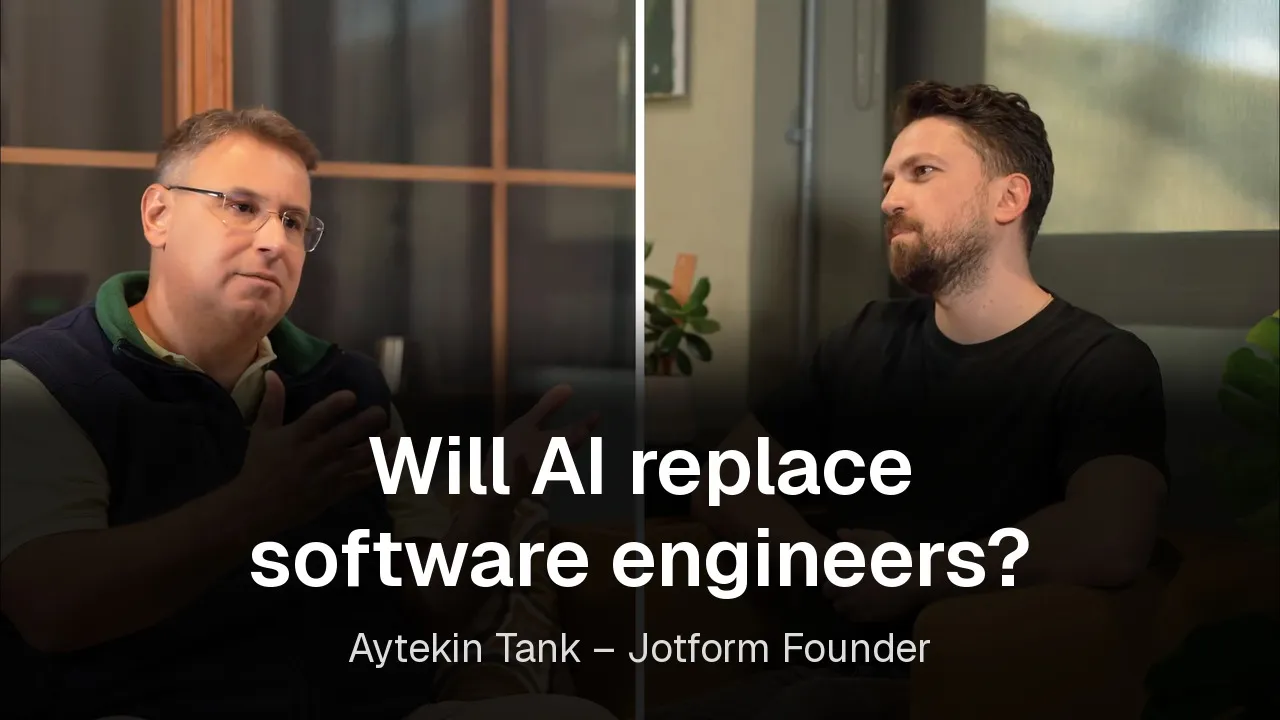
Watch the full 59-minute interview above (English dub), or the 7-minute part on developers and layoffs under the next heading.
Video summary and key insights
Aytekin Tank is the founder and CEO of Jotform, a form builder he has run for 20 years with a team of about 800 people. I'm Emre Elbeyoglu, founder and CEO of SEOmator, and in this part of my interview with him, Aytekin Tank describes how AI changed the output of Jotform's developers in two steps, why that didn't cost anyone their job, and what developers and designers do now. Watch the order of events. The gains came first, nobody lost their job, and the work moved from producing output to building the systems that produce it.
- Developers went about 2x, then about 10x. Aytekin Tank's estimate: AI inside code editors doubled output last year; writing prompts instead of code made it about ten times this year.
- There's no hand-written code left at Jotform this year, Aytekin Tank says. He himself went back to writing code after ten years away.
Now think about it. When that same team is a hundred times more productive, why would we lay them off?
- Nobody was laid off, not even in support. The support team, well over 100 people, now reviews the AI that answers users.
- Teams build factories instead of doing the work. Jotform's template team improves the factory that makes form templates instead of making them by hand.
- Accountability stays with people. "You can't get mad at AI," Aytekin Tank says; people remember a mistake and own it.
- Designers make ten options in a couple of hours. Two A/B-test versions used to take a week.
- The bottleneck moved to decisions. Deciding what to build now matters more than building it.
AI has zero accountability. Think about it. Say something breaks. Who are you going to get mad at? You can't get mad at AI.
I came into this part with a question I'd framed badly: Jotform is known for small teams of five, so were those teams down to two in the age of agents? Aytekin Tank's answer was no, and his reasons are the part most of the debate on this question leaves out. The pages that rank for "will AI replace software engineers" are mostly threads and essays arguing from opinion and anonymous experience. This is a named company's founder describing his own teams, with his own numbers.
The rest of the interview is collected in the Aytekin Tank interview hub.

Will AI replace software engineers?
AI won't replace software engineers as a profession on the evidence so far; it is replacing the typing. AI writes more and more of the code, while people still decide what to build, judge what the AI made and answer for what ships. When we analyzed the nine top results we could read on November 19, 2026, most landed on some version of that answer, while the threads among them also argued about how many engineers will be needed.
The sharpest version is from Arvind Narayanan and Sayash Kapoor, who describe software work as a "decide-execute-deliver" sandwich: "AI has compressed the middle of the sandwich, but has left the two ends largely unchanged" (their June 2026 essay). The best data behind it is a May 2026 NBER paper on more than 500,000 GitHub developers. Autonomous coding agents raised commits by an estimated 240% cumulatively, but that gain shrank to 80% for the number of projects and to 30% for actual releases (the paper was revised in September 2026).
None of the top results has a company's own leader describing, from the inside and with numbers, what happened to its engineers' output and jobs after the gains. The closest are outside reports of layoff announcements, such as Snap's. Aytekin Tank gave me that inside account. It fits the consensus and adds the part the threads can only guess at: what the engineers did next.
What happened to Jotform's developers when AI wrote the code?
Jotform's developers got about twice as productive when AI arrived inside their code editors and about ten times as productive once they stopped writing code and started writing prompts, by Aytekin Tank's estimate. He says there's no hand-written code left at Jotform this year.
Aytekin Tank described three stages:
| When | How developers used AI | Productivity, by Aytekin Tank's estimate |
|---|---|---|
| About two years ago | Asked ChatGPT for code snippets, wrote prompts | The starting point |
| Last year | AI built into the code editor | About 2x |
| This year | Writing prompts instead of code | About 10x |
Last year, their productivity probably doubled. Code editors got integrated with AI directly inside the editor. But this year, I think their productivity jumped tenfold, because they aren't writing it anymore. They write prompts.
The figures are his estimates, not measurements, and he said "probably" and "I think" himself. The adoption half of the story holds well beyond Jotform. In Stack Overflow's 2025 Developer Survey, 84% of respondents said they use or plan to use AI tools in their development process, up from 76% the year before.
There's a second change hiding in the stages. Aytekin Tank said he went back to writing code after ten years of not writing any (at 00:43). When writing code means describing what you want, the founder can do it again. Jotform's growth team saw the same thing with non-developers building internal tools, as VP of Growth Evren Bayraktar described in Jotform's AI adoption strategy.

Why didn't Jotform lay anyone off?
Jotform didn't lay anyone off because the teams moved to more valuable work: instead of doing fixes by hand, they build and improve the AI factories that do them. Aytekin Tank's reasoning is that a team that becomes far more productive is worth more, not less.
Even on the support team, nobody was laid off. What the team does is changing. Instead of doing that fix themselves, they work on building that factory, on improving and developing that factory. That's how they get a hundred times the efficiency.
The support team is the clearest case. Earlier in the interview, Aytekin Tank said AI now handles Jotform's support, and the old support team, "well over 100 people", keeps a close eye on it: how the AI should respond and how to improve it. He described Jotform's support AI in his talk on building a great AI product.
The template team went the same way. Jotform tracks what kinds of forms people create, and a team used to build matching templates by hand. Aytekin Tank says Google traffic to those templates, long a major source for Jotform's growth, was one reason Jotform outgrew its competitors during the pandemic. That traffic is shrinking now: Evren Bayraktar told me it falls month over month, a decline his team links to AI Overviews (Jotform's SEO and AI search strategy). For about a year, that team hasn't made templates. It improves the factory that makes them:
They don't make the templates by hand anymore. Instead of building templates, they improve this factory. Their efficiency is so much higher. They're way more valuable to us. Why would we shut that team down?
The other side of the debate is headcount. Seven of the nine pages we read discuss whether teams will need fewer engineers, and they don't agree. Some commenters predict one engineer will do the work of five or six; Narayanan and Kapoor argue that demand absorbs the gain. Jotform sits on the demand side, and Aytekin Tank said why: "If we can do more, why wouldn't we do more?" That holds for a company with more ideas than capacity. A company with a fixed amount of work would face a different choice.

What does an engineer's job become?
At Jotform, an engineer's job becomes building, reviewing and improving the systems that write the code, which Aytekin Tank calls AI factories. Most of the ranking pages (seven of nine) describe the same move "up the stack" in general terms. Jotform's version is concrete.
The bug-fix factory shows what that means in practice. In the parts of the product where it runs, a ticket that a person opens passes through a chain of AI agents that reproduce it, decide the fix, design it, build it, test it for security and user experience, ship it and reply to the user. The developers don't do those steps; they work on the factory. Every step, and the three rules Aytekin Tank runs it by, is in our explainer on how Jotform's software factory works.
Two parts of the job stay with people. Judgment about quality is the first: the factory's design agent makes decisions a designer still has to review, as the next sections show. Choosing what to build is the second: Aytekin Tank says the factory can multiply output, but someone has to decide what it should produce. The Reddit and Hacker News threads in the top results keep returning to code quality, with AI-written code full of bugs and security holes when nobody checks it. Jotform answers that inside the factory, with QA agents for security and user experience before anything ships, and people reviewing the result.
Why can't AI take responsibility for the work?
AI can't take responsibility because it can't be held to account: you can't tell it a mistake must not happen again and trust it to remember, while people understand and own that responsibility. That's Aytekin Tank's argument, and most of the pages we read (seven of nine) make a version of it.
You can't get mad at AI, but you can tell people: look, this shouldn't happen, let's not do that again. You can say things like that because these people actually understand that responsibility. AI is way more likely to forget it.
Developers draw the same line. In Stack Overflow's 2025 survey, respondents showed the most resistance to AI for high-responsibility, systemic tasks: asked about the next three to five years, 76% said they don't plan to use it for deployment and monitoring, and 69% said the same for project planning.
Jotform has organized its teams around that gap. Aytekin Tank said the six-person team was never about six people's worth of work. It brings different disciplines to the same problem, and the factory still needs them: developers can't review the design agent's decisions or give it useful feedback, so a designer has to. That is why teams aren't shrinking, in his words, even as AI does more of the producing.
What changed for designers?
Jotform's designers no longer draw every design by hand in Figma; they generate options with AI and spend their time choosing. Two versions for an A/B test used to take a week; now a designer generates ten in a couple of hours and picks two to test, Aytekin Tank says. Only two of the nine pages mention designers at all.
In my view, the most important part of a designer's job is knowing what's right, what's clean, what looks good. Now designers sit down and in a couple of hours, they generate 10 designs. Then out of those 10, they pick two and put them into testing.
Before and after, as Aytekin Tank described the A/B test workflow:
| Step | Before AI design tools | Now |
|---|---|---|
| Tool | Designs drawn by hand in Figma | Claude Design, which he said pushes straight to Figma |
| Time | About a week | A couple of hours |
| Versions made | Two | Ten |
| Versions tested | Two | The best two of ten |
Designers went through the same shift as developers. Making a design got cheap, so the skill that counts is knowing which of ten options is right. That's also why the designer can't be removed from the bug-fix factory. Someone with that taste has to review what the design agent decides.

Why are some tech companies cutting jobs anyway?
In Aytekin Tank's view, large Silicon Valley companies were already overstaffed, especially after the move to remote work, and are using AI as an excuse for cuts they needed anyway. That's his opinion, and four of the nine pages we read point the same way: the cuts are real, but cost pressure or executives' belief in AI drives them more than AI doing the work.
Yeah, layoffs are happening in Silicon Valley. But I think those companies were already way over bloated with hundreds of thousands of employees, especially after switching to remote work. They have to lay people off. Here, they're basically using AI as an excuse.
The data so far challenges the idea that AI is already doing those engineers' jobs:
- Executives cut in anticipation. A Harvard Business Review survey of 1,006 global executives in December 2025 found AI is behind at least some layoffs, but almost completely in anticipation of AI's impact, not its actual performance.
- Nobody filed AI as the cause. In New York, which added an AI checkbox to layoff notices, more than 160 companies filed notices in the first year and not one attributed its layoffs to AI, law firm Hunton reported in May 2026. Hunton adds that this may partly reflect a reporting system employers find unclear.
- Job growth slowed instead. A Federal Reserve paper from March 2026 found that US coder employment "has continued to grow in recent years, though much more slowly than it did pre-2022."
Five of the nine pages also say juniors are hit first, as entry-level roles shrink and seniors get more done with AI. Aytekin Tank didn't address juniors in the interview, so Jotform's account can't settle that part. For the wider picture of how companies are taking up AI, see our guide to AI adoption at work.
Does speed make decisions harder?
Speed moves the bottleneck from people doing the work to people making decisions, Aytekin Tank says, and that makes choosing what to build more important than building it. I asked the question near the end of this part.
Emre Elbeyoglu: With AI speeding things up this much, doesn't decision-making get a bit harder? Speed is always out in front. Every single decision is huge in a product like yours.
Aytekin Tank: Up until AI came along, our bottleneck was always people. We moved so slowly; we'd struggle for months just to build one thing. Using AI doesn't mean productivity suddenly shoots up a hundredfold. Once you set up the factory, it hits 100x, and setting up that factory takes months. Here, making decisions actually becomes the most important thing.

If AI makes building cheap, the scarce skill is deciding what's worth building, and that is the layer Narayanan and Kapoor say resists automation. Aytekin Tank added that Jotform still has more ideas than it can build: "There's just never an end to the work" (at 06:45). A company in that position needs more people who decide well, not fewer.
Frequently asked questions
Will AI replace software engineers in the future?
Not as a profession, by the evidence so far. AI now writes much of the code, but people still decide what to build, judge what the AI produced and answer for what ships. At Jotform, founder Aytekin Tank says AI made developers about ten times as fast this year and nobody was laid off; the engineers moved to building the AI factories that do the work. A Federal Reserve paper from March 2026 found that coder employment in the US is still growing, though much more slowly than before 2022, so far the change shows up as slower job growth rather than mass replacement.
Will software engineers still exist in 10 years?
Very likely, though the job will look different. Aytekin Tank's account of Jotform shows the direction: developers stopped writing code by hand, then stopped doing routine fixes, and now build and improve the factories that do them. What remains human is the work at both ends: deciding what to build and answering for what ships. Researchers Arvind Narayanan and Sayash Kapoor call this the decide-execute-deliver sandwich, where AI compresses the middle layer and leaves the two ends largely unchanged. Nobody can promise the shape of the job in 2036, but the deciding and the accountability have not moved to AI so far.
What jobs will AI not replace?
Jobs whose core is judgment and accountability look the hardest for AI to replace, on the evidence so far. Aytekin Tank's example is the designer: AI can now produce ten design options in a couple of hours, but knowing which one is right, clean and good still takes a person. He makes the same point about responsibility: you can tell a person that something must not happen again, while AI has no accountability and is more likely to forget. Developers seem to agree. In Stack Overflow's 2025 Developer Survey, 76% of respondents said they don't plan to use AI for deployment and monitoring over the next three to five years, and 69% said the same for project planning.
Will AI replace programmers in the next 10 years?
AI is replacing the typing part of programming faster than the programmers. At Jotform, Aytekin Tank says developers went from asking ChatGPT for code snippets two years ago to working about ten times faster this year by writing prompts instead of code, and no one lost their job. A May 2026 NBER paper on more than 500,000 GitHub developers found that autonomous coding agents raised commits by an estimated 240% but releases by only 30%, because the bottlenecks sit outside writing code. Programmers who move to specifying, reviewing and building the systems that write code look best placed for the next ten years.
Did Jotform lay off developers because of AI?
No. Aytekin Tank says nobody was laid off at Jotform as AI took over the work, not even on the support team, which had well over 100 people before AI started handling support. His reasoning: if the same team becomes many times more productive by building AI factories instead of doing the work by hand, there is no reason to let it go. A smaller company that can suddenly do more should do more. The support team now reviews the AI's answers and works on improving them.
What do developers do when AI writes the code?
At Jotform, developers build and improve the AI factories that do the work. Aytekin Tank's example is the bug-fix factory: instead of fixing each bug, the team works on the chain of agents that reproduces, fixes, tests and ships fixes, which he says makes the team about a hundred times more productive once the factory runs. The same happened to Jotform's template team, which now improves the factory that makes form templates instead of making them by hand. The work moves from producing the output to designing, reviewing and measuring the system that produces it.
Why can't AI be held accountable for software?
Because accountability needs someone who can be told, remember and change. Aytekin Tank's version is blunt: when something breaks, you can't get mad at AI, but you can tell people that it must not happen again, and they understand that responsibility. AI, in his words, is way more likely to forget it. That is why Jotform keeps cross-functional teams of people around its AI factories, so a designer reviews what the design agent decides and someone owns each result. Accountability also has a legal and commercial side: a customer or a court needs a person or a company to answer.
Which AI coding tool does Jotform use?
Jotform uses OpenAI's Codex company-wide, according to Aytekin Tank. Later in the same interview he said he used to use Claude a lot more, but that the whole company had pretty much switched to Codex, and that he still checks Claude from time to time to see what he might be missing. His reason was style: he finds ChatGPT and Codex more decisive, while Claude, in his experience, pushes back more on instructions. Jotform's designers, separately, use Claude Design, which he said pushes its output straight to Figma.
Why are big tech companies laying off engineers if AI makes them more productive?
Aytekin Tank's view is that large Silicon Valley companies were already overstaffed, especially after the move to remote work, and use AI as an excuse for cuts they needed anyway. The data so far challenges the idea that AI is already doing those engineers' jobs. A Harvard Business Review survey of 1,006 global executives in December 2025 found AI is behind some layoffs, but almost entirely in anticipation of its impact rather than its actual performance. In New York, more than 160 companies filed layoff notices in the first year after the state added an AI checkbox, and not one attributed its layoffs to AI.
Key takeaways
- So far, AI is replacing the typing more than the software engineers, and the work moves to deciding, reviewing and building the systems that write code.
- Aytekin Tank estimates Jotform's developers got about 2x faster with AI in the editor and about 10x faster by writing prompts instead of code.
- Nobody was laid off at Jotform; teams moved from doing the work to building the AI factories that do it.
- People stay accountable for what ships. "You can't get mad at AI," as Aytekin Tank put it.
- Designers at Jotform now generate ten options in a couple of hours and spend their time choosing.
- The layoff data so far shows cuts made in anticipation of AI and slower job growth, more than AI doing engineers' jobs.
- Faster building makes deciding what to build the scarce skill.
For more first-hand accounts like this one, join the GrowthMarketing.ai newsletter.
Methodology: this post is based on an interview I recorded with Aytekin Tank in Turkish in 2026. Quotes come from the English dub, checked against the Turkish original and lightly edited for clarity. The productivity multiples are Aytekin Tank's estimates for Jotform, not measurements by GrowthMarketing.ai. The "top results" are the Google results for "will AI replace software engineers" in the US on November 19, 2026, nine of which we could read.