
Why startup playbooks stop working: context, cold outreach, and the traffic nobody can predict
Startup playbooks fail when the context changes. Amir Nurmagomedov and I unpack why cold outreach flopped once and worked later, and why AI traffic is next.
Published 11 min read

Founder, GrowthMarketing.ai
15+ years of experience
Emre Elbeyoglu is a B2B SaaS growth expert and Founder of GrowthMarketing.ai. With 15+ years of SEO and GEO experience, he studies search and AI ranking systems to support growth work for brands including Rakuten and Investing.com. He has also bootstrapped SaaS products including Popupsmart and LiveChatAI.
- Computer Technology & Information Systems, Bilkent University
- Co-founder & Growth Lead, Popupsmart (since 2019)
- Co-founder, LiveChatAI (since 2023)
Share article
Explore with AI
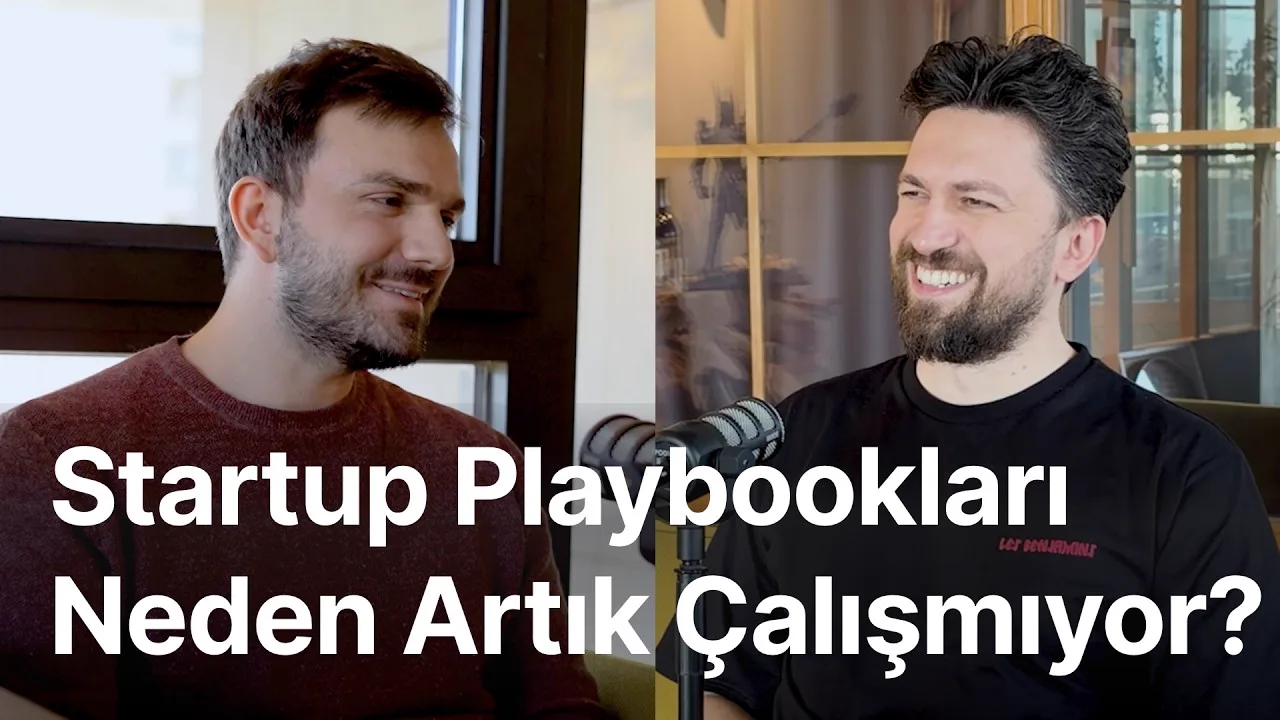
Startup playbooks stop working because the context they came from never repeats: not the timing, not the method, not the competition. In this short clip from my conversation with Amir Nurmagomedov, cold outreach is the proof, a channel that got zero replies on one product and started converting on another, while ChatGPT traffic is the next channel nobody can forecast.
Video summary and key insights
This is a two-and-a-half-minute cut from my Turkish interview with Amir Nurmagomedov, co-founder of CompanyEnrich.com and a founder who has shipped four SaaS products, sold two, and shut one down. The topic is narrow: why the growth playbooks founders pass around stop producing results when someone else applies them. Amir's evidence is cold outreach. His team tried it early on and got nothing back; with CompanyEnrich, the same channel started returning replies. The single takeaway, which we both land on, is that a method working somewhere else does not mean it works in your context, and that the only honest use of a playbook is as a list of experiments to run.
- Playbooks describe a context, not a method. The steps are the visible part. The timing, the competition, and the product they were attached to are the part that made them work. Copy the steps and you copy none of that.
- The same tactic can fail and succeed inside the same team. Amir's cold outreach got zero replies on an early product and started converting with CompanyEnrich. Nothing about "cold email" changed. Everything around it did.
People always think: if they did it like that and I do the same, I'll get the same result. It doesn't work like that. It's not the same time, the method isn't the same method, the competition isn't the same.
- Timing alone can flip the result. Even when most conditions match, I point out at 00:29, trying the same thing in a different year can produce a different outcome. That is an argument for dating every case study you read.
- Cold outreach has more variables than any other channel in the clip. Targeting, trigger, deliverability, offer, and product all move at once, which is why it resists playbook treatment more than most.
- Playbooks earn their keep as idea generators. Amir's framing: "maybe I can try it and catch something from it." Useful for hypotheses, useless as instructions.
- AI traffic is the live example of an unforecastable channel. ChatGPT sends traffic today and everyone is pushing on it. Neither of us would bet on what that looks like in a year, and we say so on camera.
The playbooks we see might be good for ideas, maybe for an experiment. But only as context: there's this thing, maybe I'll try it and catch something from it. In that sense they're useful.
I cut this clip out of the longer interview because it is the part I keep coming back to. The full conversation covers ten years of Amir's bootstrapped SaaS work in detail. This piece is only about one idea in it, and I'm writing it up because I've watched the same playbook produce opposite results in my own companies and never had a clean way to explain why. Quotes below are translated from Turkish and lightly edited.
Why don't startup playbooks transfer?
They don't transfer because they are outputs of a context, and the context is the part that doesn't get written down. Everyone in startups has read a "how we got our first 1,000 customers" post and tried to replay it. Sometimes it works. Usually it doesn't, and the failure gets blamed on execution rather than on the fact that the original author was operating in a different year, against different competitors, with a different product.
My version of this in the clip is blunt:
A playbook only means something inside the context you're living in while you apply it.
Fifteen seconds later I push it further: even when most of the conditions are the same, trying the tactic in a different year can make it turn out differently. What I'd add now, with a bit of distance: the time variable is the one founders underweight most. A channel's yield decays as more people use it, and most playbooks are published after the author has already extracted the easy gains. By the time you read it, you're competing with everyone else who read it. That's not a reason to ignore playbooks. It is a reason to ask when the tactic worked before asking how.
Does cold outreach still work, or doesn't it?
Both, and that is exactly the point. Cold email is the tactic every playbook has an opinion about, usually a strong one in either direction. Amir's team has a rare dataset: the same people, running the same channel, on two products years apart.
We tried cold outreach way back, sending emails and so on. Nothing. We couldn't get any replies. But with the latest one, CompanyEnrich, we've started getting responses from cold outreach.
In the full interview Amir tells the early story in more detail: they bought a list of domains that used competing products, built an importer tool, sent the emails, and got zero response. The CompanyEnrich version sits on top of a crawl of roughly 50 million domains and targets companies on change signals rather than static lists. Laid side by side, the channel is the only constant:
| Variable | Early attempt (zero replies) | CompanyEnrich (replies started) |
|---|---|---|
| Channel | Cold email | Cold email |
| Target list | Bought list of domains using competing products | Own crawl, roughly 50M domains |
| Trigger | None (static list) | Change signals (funding, headcount, stack changes) |
| Product | Announcekit, pitched cold to those domains | CompanyEnrich, a B2B data product |
| Timing | Seven or eight years ago | 2024 onward |
My own read on why this channel is so resistant to playbooks:
Cold outreach is a whole different world for us too, especially on the email side, because it has so many variables. Cold outreach and email are completely different worlds, and it changes a lot by product and by method.
"So many variables" is doing real work in that sentence. Deliverability alone is a moving target: Google's bulk sender requirements now tie inbox placement to authentication, spam-rate thresholds, and one-click unsubscribe, none of which existed in the playbooks written before 2024. Stack a changing target list, a changing trigger, and a changing product on top of that and you have a channel where last year's results tell you very little. Amir calls it "a strange equation" later in the clip, and I think that's the right level of humility.
What are playbooks actually good for?
They are good for generating experiments. Amir's framing at 01:11 (quoted above) is the most useful definition of a playbook I've heard: "there's this thing, maybe I'll try it and catch something from it." Not a recipe, a backlog item.
That reframing changes how you read case studies. Instead of asking "did this work?", you ask "what would it cost me to find out whether this works here?" For cold outreach, that might be 200 emails over two weeks against one change signal. For a content channel, one month and five posts. If the experiment is cheap, the playbook has paid for itself even when the answer is no, because you've eliminated a channel with data instead of with opinion. It is the same logic Metehan Yeşilyurt described in our conversation about growth experiments, and Amir got there from the operator side rather than the marketing side.
Will traffic from ChatGPT still be there in a year?
Nobody knows, and the clip ends on exactly that admission. Amir brings up AI traffic as the current example of a channel everyone is chasing without knowing its shelf life:
Amir Nurmagomedov: There's no single growth thing I've seen or come across, because it keeps changing. Right now there's traffic coming from ChatGPT and the like. Everyone is going hard on that. A year from now, what happens?
Emre Elbeyoglu: We don't know. We can't even imagine it anymore. Just like we couldn't imagine this three years ago.
Amir Nurmagomedov: Exactly. So you have to know about these things and adapt when you need to.
I stand by "we don't know", and I'd rather say it on camera than pretend otherwise. We're already spending real effort on AI search here: we documented a programmatic AI SEO experiment that went from zero to 150k visits a month and we follow how Google Preferred Sources feed AI Overviews and AI Mode. None of that tells us what the channel looks like in twelve months. What it does is exactly what Amir recommends: know the channel well enough to adapt when it moves. If AI traffic turns into a playbook, it will stop working for the same reason every playbook in this clip did. The people who do well will be the ones who treated it as an experiment with a date on it.
Frequently asked questions
Why do startup playbooks stop working?
Because a playbook is a record of what worked for one company, at one time, against one set of competitors. Amir Nurmagomedov's point in the clip is that the time, the method, and the competition are never the same twice, so copying the steps rarely copies the result. The same tactic tried a year later, with most conditions unchanged, can still land differently.
Is cold email dead for startups?
No, but it is product-specific. Amir's team got zero replies when they tried cold outreach on an early product and started getting responses years later with CompanyEnrich. Same channel, different product, different data, different timing. The lesson is not that cold email works or doesn't; it is that the channel only tells you something once you have tested it in your own context.
Is cold email still effective in 2026?
It can be, but it has more variables than most playbooks admit: who you target, what signal triggers the email, deliverability and sender reputation, the offer, and the moment in the buyer's stack. Emre's view in the clip is that cold outreach and email are a different world from other growth channels and that what works is specific to the product and the method.
What should founders use playbooks for, then?
As a source of experiments, not instructions. Amir describes playbooks as useful for ideas and for trials: there is this thing, maybe I can try it and catch something from it. Read them for hypotheses, keep your own context in mind, and run small tests before committing a quarter to someone else's channel.
How should a startup think about traffic from ChatGPT and AI search?
As a real channel today with an unknown shelf life. Amir notes that traffic from ChatGPT and similar tools exists now and that everyone is pushing hard on it, then asks what happens a year from now. Emre adds that nobody can predict it, just as nobody predicted this three years ago. Treat it as a channel to measure and adapt to, not a permanent playbook.
Where is the full conversation with Amir Nurmagomedov?
This two-and-a-half-minute clip is cut from a longer Turkish interview about Amir's ten years of bootstrapped SaaS work: four products, two exits, one shutdown, and the data business that came out of it. The full English write-up, including the cold email anecdote in detail, is on growthmarketing.ai under the title He Built Four SaaS Startups. Sold Two. Killed One.
Key takeaways
- A playbook is the visible half of a result. The timing, the competition, and the product it was attached to are the invisible half, and that half is what made it work.
- Cold outreach produced zero replies on one of Amir Nurmagomedov's products and started converting on CompanyEnrich. The channel was constant; the target data, the trigger, the product, and the year were not.
- Cold email has more moving variables than most growth channels, deliverability rules included, which is why it resists playbook treatment the most.
- Use playbooks as a backlog of cheap experiments, not as instructions. A failed test that cost two weeks is still a better answer than a borrowed opinion.
- Traffic from ChatGPT and AI search is today's unforecastable channel. Know it well enough to adapt, and put a date on every assumption you make about it.
This post is based on Startup Playbookları Neden Artık Çalışmıyor? (Cold Outreach & Context Meselesi) by Emre Elbeyoglu. Quotes are translated from Turkish and lightly edited for clarity.