
SEO and GEO strategies from nine experts at Sydney SEO Conference 2026
Nine SEO and GEO experts spoke at Sydney SEO Conference 2026. I watched all 3.5 hours: trust beats relevance, 95% of AI citations are junk, and they disagree.
Published 29 min read

Founder, GrowthMarketing.ai
15+ years of experience
Emre Elbeyoglu is a B2B SaaS growth expert and Founder of GrowthMarketing.ai. With 15+ years of SEO and GEO experience, he studies search and AI ranking systems to support growth work for brands including Rakuten and Investing.com. He has also bootstrapped SaaS products including Popupsmart and LiveChatAI.
- Computer Technology & Information Systems, Bilkent University
- Co-founder & Growth Lead, Popupsmart (since 2019)
- Co-founder, LiveChatAI (since 2023)
Share article
Explore with AI
Nine SEO and GEO specialists spoke at Sydney SEO Conference 2026, and Prosperity Media stitched all nine talks into one 3.5-hour video. I watched the whole thing. The headline finding: users filter by trust before relevance, 95% of AI citations are junk, and the nine experts disagree sharply about whether GEO is even a separate discipline.
Video summary and key insights
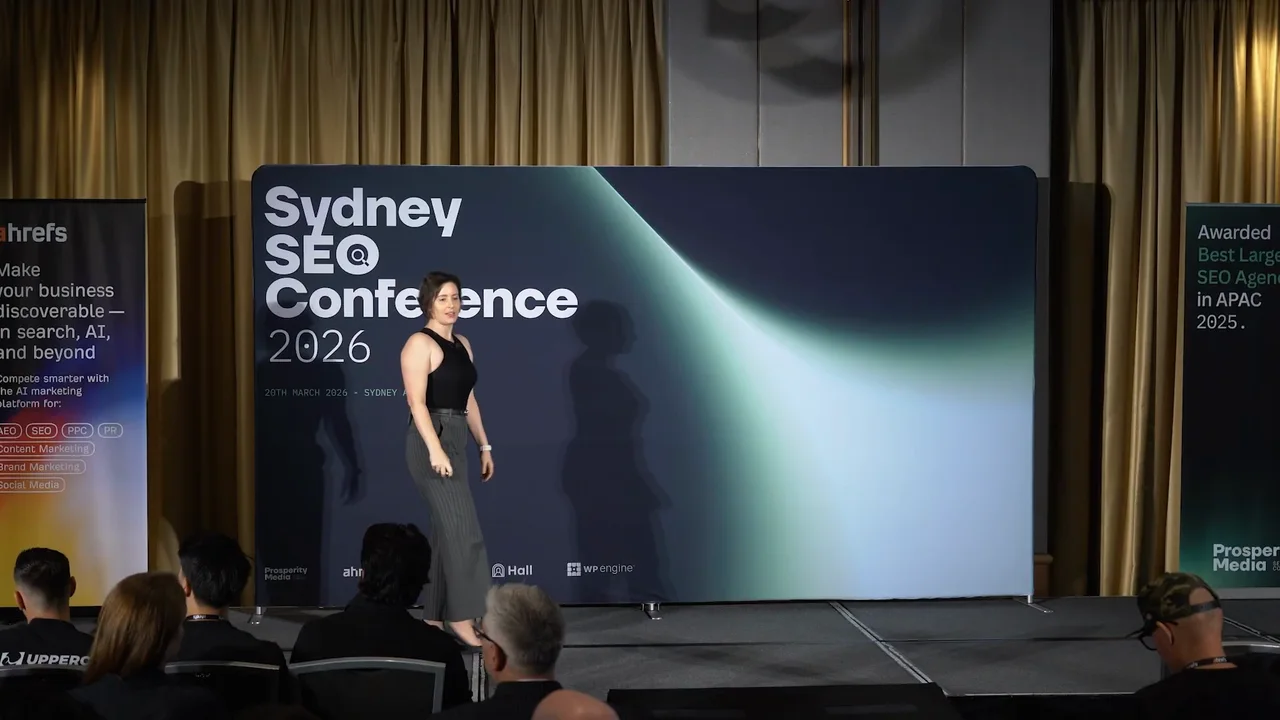
This is the full recording of Sydney SEO Conference 2026, held on 20 March 2026 and organised by Prosperity Media, an Australian agency named best large SEO agency in APAC in 2025. Nine speakers each got roughly twenty to thirty minutes, and the running order deliberately mixes people who do not agree. The core question underneath every talk is what replaces the click now that AI answers absorb it. The single most useful thing in the video is not any one playbook. It is watching nine practitioners with real client data arrive at the same destination, being known, by nine different routes, while openly contradicting each other on how to get there.
- Users apply a trust filter before a relevance filter. Kevin Indig ran two lab studies with 35 and 70 participants and found people ask "do I know this brand" before they ask "does this answer my question". That reorders the entire optimisation stack.
- Traffic and conversions have come apart. Indig showed a client whose organic traffic fell 50% year over year while conversions grew almost 20%. Purchase intent did not disappear; the click did.
- 95% of AI citations are worthless. Brie Moreau's team analysed over two million AI citations across 30 industries and found the overwhelming majority appear once or twice and never return.
- AI citations barely overlap with Google. Moreau put the overlap at 12%, with his own replication at 14%, and ChatGPT's overlap with Bing at 26%. "Just do good SEO" is not a complete GEO strategy.
- Language models retrieve chunks, not pages. Frank Duignan pegged a standard chunk at 512 tokens, roughly 400 words, and said up to 15% of model output is verbatim web snippets of about 50 characters or fewer.
- Your reviews are probably invisible. Destiny Flaherty demonstrated a product page carrying 17,000 reviews that language models could not read, because the widget renders in third-party JavaScript.
- The junior SEO tasks are already automated. Patrick Stox, who built Ahrefs' bulk-fix tooling, said he would not build it that way today and that "checklist SEOs" are the ones at risk.
The number one filter is not relevance, but trust. When people evaluate their answers, they first ask themselves, when they see a brand: do I know this brand? Do I trust this brand? And then they go to relevance.
- Fame is the proposed replacement for the checklist. Jes Scholz argued for a 60/40 split between brand building and activation, and for share of voice as the KPI instead of rankings or sessions.
95% of AI citations are junk. Most AI citations get shown once or twice and just never come back.
I've spent fifteen years reverse-engineering how ranking systems decide what to surface, and most conference recordings I sit through turn out to be one idea stretched over half an hour. This one isn't. It's nine separate arguments, several of them incompatible, and the incompatibility is the part I got value from. I took notes for three days and rewatched four of the talks.
So this is not a transcript summary. I kept the claims that carried evidence, went and read the studies where a speaker named one, and marked every spot where two people on the same stage contradicted each other. Where I think a speaker is wrong, I say so. Quotes are lightly edited for clarity, and every timestamp links to the exact second, so you can check me rather than take my word for it.
Who spoke, and where to follow them
Nine speakers, in running order. I've linked each one so you can check their work rather than take my summary of it, which is the whole argument of the Jes Scholz section further down.
| Speaker | Role | Talk | Profiles |
|---|---|---|---|
| Kevin Indig | Growth advisor, ex-Shopify and G2 | Beyond the SERP: the visibility layer and trust stack | LinkedIn · X |
| James Norquay | Founder, Prosperity Media | Digital PR and GEO growth to dominate APAC | LinkedIn · X |
| Lauren Schwartz | Digital strategy manager, Maid2Match | Beyond the map pack: building a local brand | |
| Jes Scholz | Growth marketing consultant | Forget EEAT: SEO is fame | LinkedIn · X |
| Brodie Clark | Independent SEO consultant | Enterprise SEO for ecommerce and marketplaces | LinkedIn · X |
| Patrick Stox | Product advisor, Ahrefs | Technical SEO is dead | LinkedIn · X |
| Frank Duignan | GEO lead, Prosperity Media | How LLMs really work | |
| Destiny Flaherty | Head of SEO, Princess Polly | The ecommerce playbook for GEO | |
| Brie Moreau | Founder, Whitelight Digital Marketing | We analysed 2M+ AI citations |
Why did organic traffic stop predicting revenue?
Because clicks and conversions decoupled roughly twelve months ago, and most reporting has not caught up. Kevin Indig calls the break "the Rift": the point where organic traffic separated from organic rankings after Google expanded AI Overviews in March 2025.
His evidence is unusually concrete. Looking at non-branded keywords for the three largest sites on the web by traffic, YouTube, Reddit and Wikipedia, he found AI Overviews on about 50% of them. The Pew Research study he cites tracked 900 US adults across 68,879 searches in March 2025 and found users clicked a traditional result on 8% of visits where an AI summary appeared, against 15% where it did not. Clicks on links inside the summary itself: 1% of visits.
Traffic is just not a leading indicator anymore.
The finding that reordered my own thinking came from his lab studies. Participants were given tasks, then asked to narrate their reasoning. The first question people asked when they saw a result was not whether it answered them. It was whether they recognised the brand.
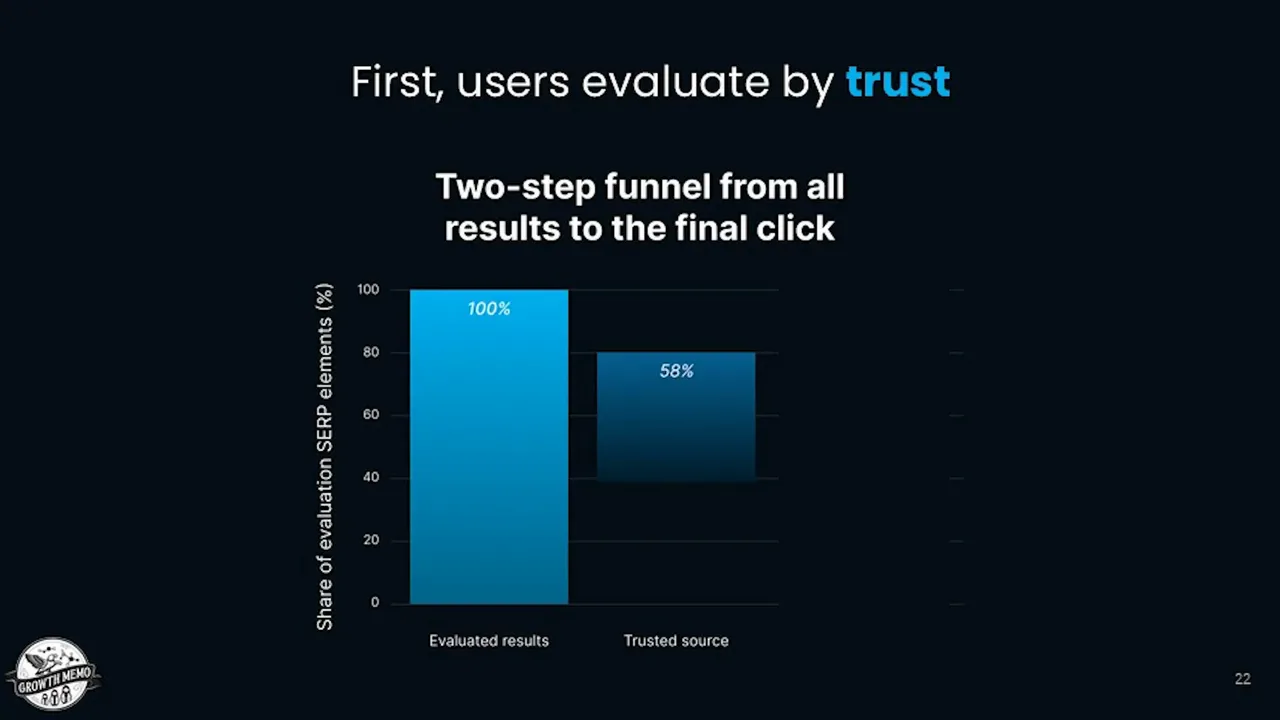
Here's the consequence I keep coming back to. If trust is the first gate, then everything you do to be recognised before the search happens is search work, even when it produces no measurable clicks. That's an uncomfortable argument to take to a finance team, and I'd still rather have it than keep walking a ranking chart into a revenue conversation. Jes Scholz spends her whole talk on how to win it.
One tactic from Indig's talk is cheap enough to test this week. He showed client data where citation rate tripled after adding a visible last-updated date across a large site's landing pages, alongside genuine updates to the content.
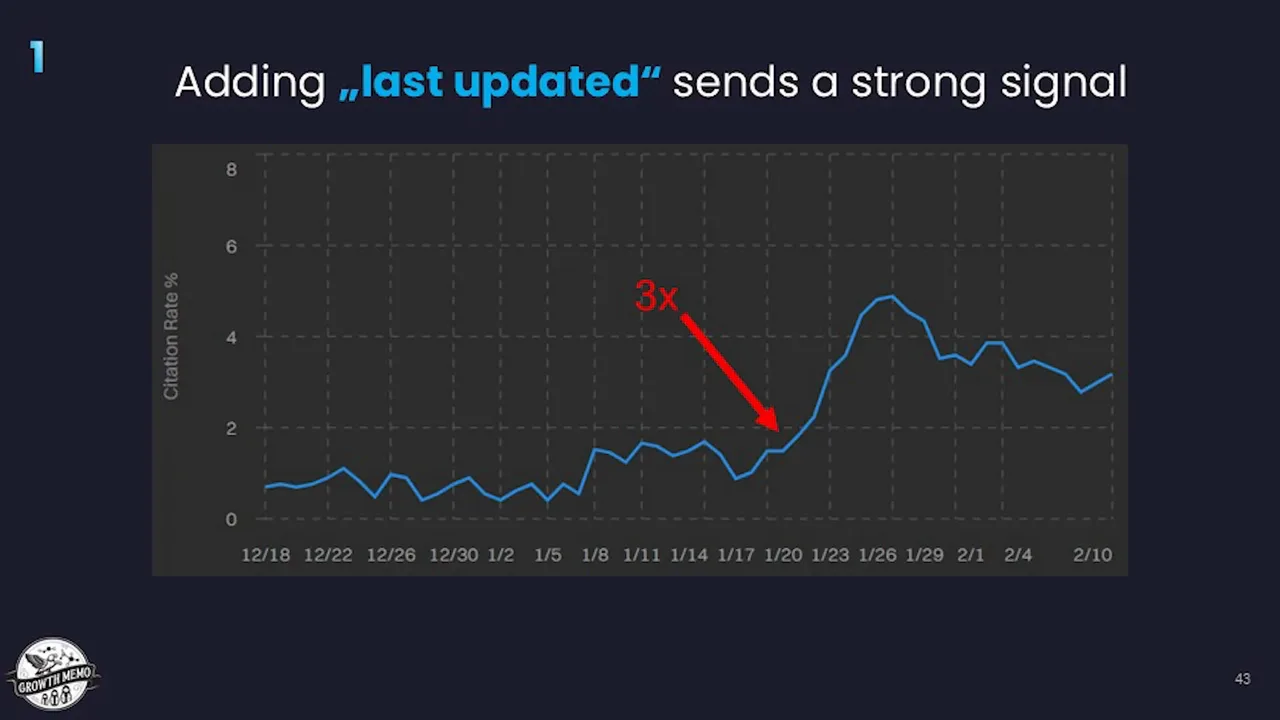
I'd treat the 3× as directional rather than a benchmark. He changed two things at once, the date and the content, and he says so on stage. It's still the highest ratio of impact to effort in the whole video, and Brie Moreau disputes the premise entirely later on.
Is E-E-A-T still worth doing, or is SEO just fame now?
It's worth doing and it will not differentiate you. That's the honest reading of Jes Scholz's talk, which is titled "Forget EEAT: SEO Is Fame" and is more careful than the title suggests.
Her argument is about where best practices come from. SEOs read Google's quality rater guidelines, convert them into prescriptive tactics, and repeat those tactics until they feel like law.
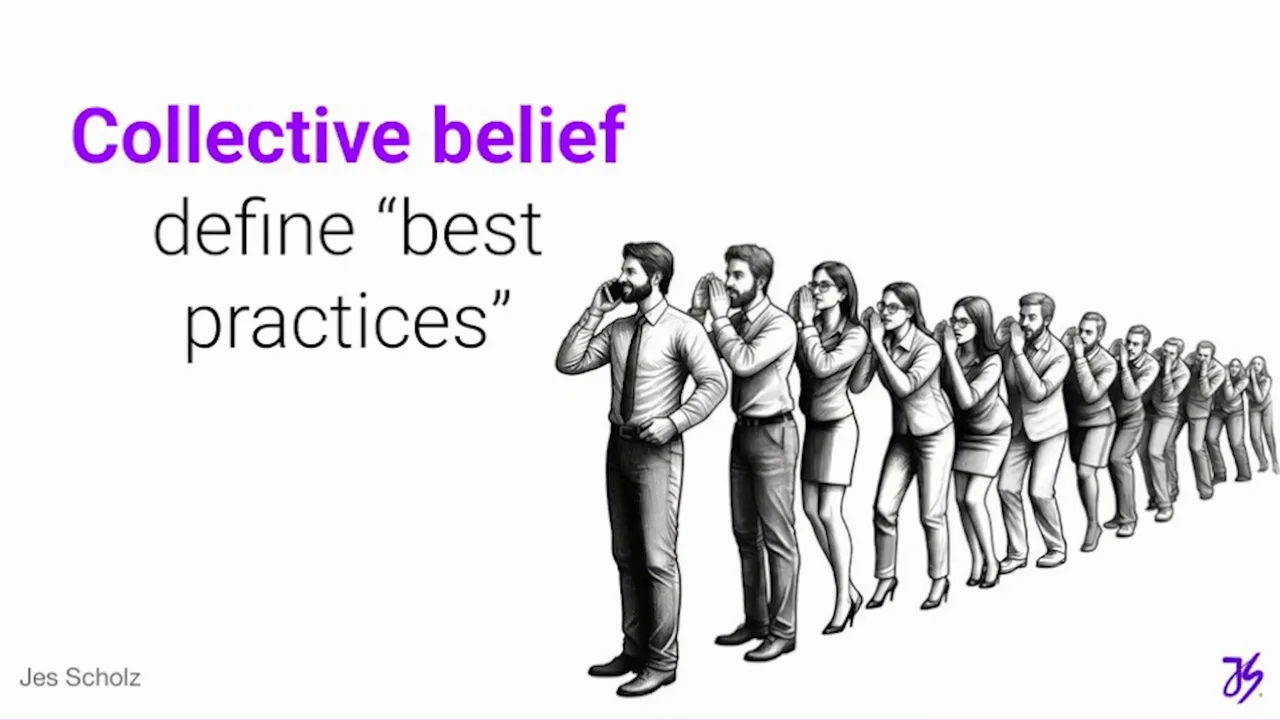
Read the next quote carefully, because it's the part that gets dropped when this talk is summarised as "E-E-A-T is dead".
I'm not saying that this is not a good practice. I'm just saying it's really common practice. That is a defensive play to not lose position.
She isn't saying skip author pages. She's saying author pages are the price of entry, and you should stop reporting them as strategy. Her replacement is fame, built from three drivers: showmanship, distinctiveness and distribution. The measurement swap is the concrete part. Instead of rankings or sessions, she wants share of voice, on the basis that share of voice and market share sit in an equilibrium, and roughly 10% excess share of voice buys about 1% of market share.
I'll declare my own position here, because this is the part of the video I argued with out loud. I run a byline, an author page and a credentials block on this site, and I'm keeping all three. Scholz hasn't convinced me they're worthless. She has convinced me I was counting them wrong: they belong in the column marked "not losing", next to HTTPS and a working sitemap, and I had been quietly filing them under "why we win". Those are different budgets and different expectations.
Stop reading Google guidelines and start reading a thing called books.
The books are Les Binet, Peter Field, Andrew Tindall, Jenni Romaniuk and Byron Sharp. The underlying claim, that only 5% to 30% of a market is in-market at any moment and the rest go direct when they arrive, is standard marketing-effectiveness research rather than anything SEO invented.
Her sharpest test is one I've since started applying to drafts:
If I can take a piece of creative from your website or from your socials and, without any significant creative edits, plunk that onto your competitor and it still works, that piece should never have been published.
That's the same idea as the three-layer non-commodity content checklist I use here, arrived at from the brand side rather than the search side. Her version is faster to apply because it takes about four seconds.
Where I'd push back: share of voice is a better KPI, and it's also the one most teams cannot get without buying a tool or commissioning research. Scholz names DemandSphere and Sprout Social on stage. If your measurement budget is zero, "measure share of voice instead" is advice you can agree with and still not act on. I've watched that gap swallow good strategy before: the metric everyone nods at is the one nobody owns by Friday. Pick the imperfect proxy you can pull yourself over the correct one you'll never see.
What actually gets cited in AI answers?
Very little, and not what you'd guess. Brie Moreau's team at Whitelight put over a thousand hours into analysing more than two million AI citations across roughly 30 industries, in partnership with DataForSEO, and the top-line finding is brutal.
He opened by having the room pull out their phones and ask ChatGPT for the best hotel in Hawaii.
Everyone got the same two hotels. His point is that personalisation in these systems is far shallower than the marketing suggests, and that every niche has its own Four Seasons and Ritz-Carlton absorbing the citations.
The mechanism he proposes is co-citation similarity, borrowed from academic citation analysis: if many documents that answer a query cite the same sources, those sources acquire authority for that query. His team mapped the networks and found the pattern holds.
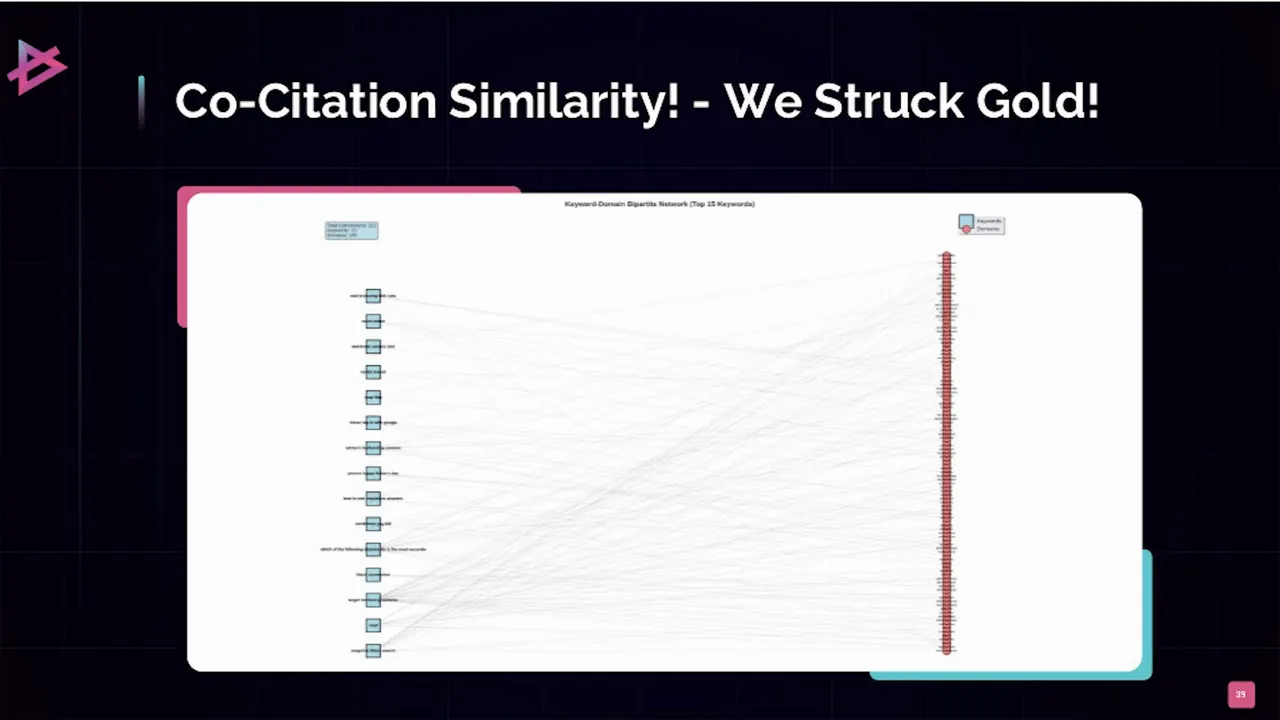
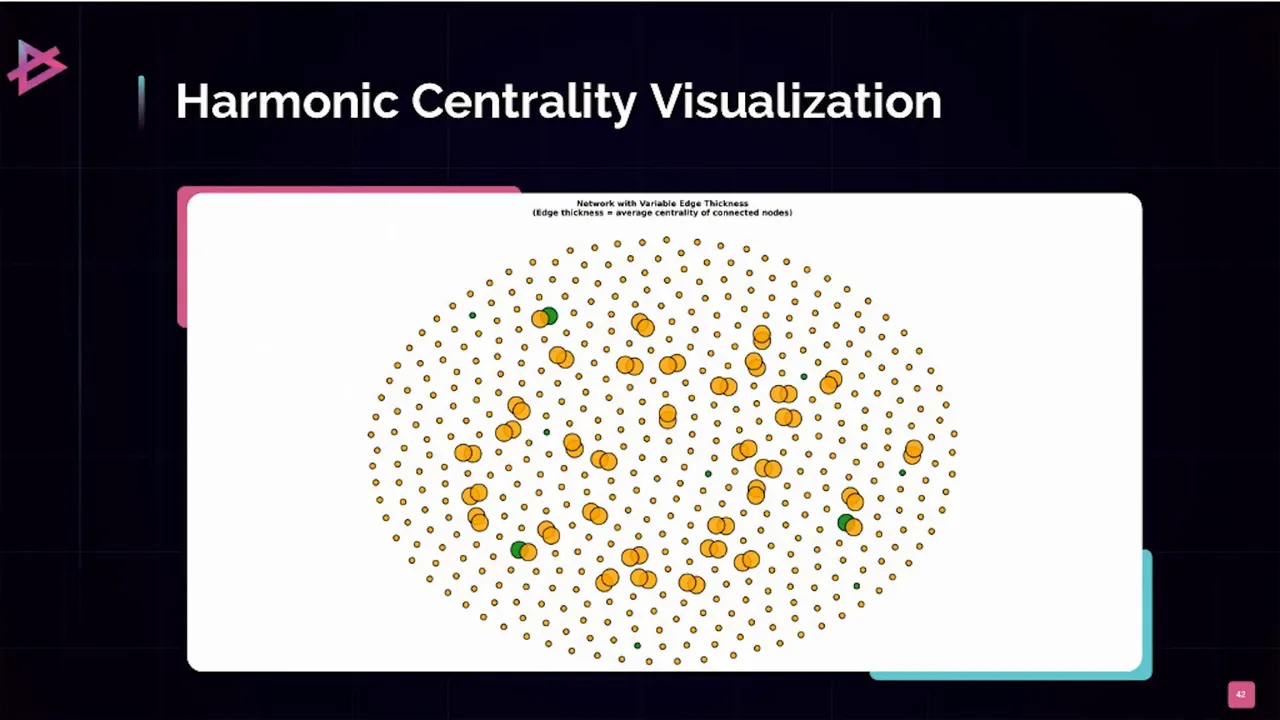
For one blackjack dataset, 3,000 AI citations collapsed to 127 pages that actually sit inside the citation network. That ratio is the practical version of "95% is junk": most of what an AI visibility tool reports is noise, and a small set of nodes does the work.
If he's right, most AI visibility dashboards are counting the wrong thing, mine included. A rising citation count means very little if the citations evaporate next week. The number I want is how many of my citations come from inside the network, and I don't have a clean way to pull that yet. Moreau built an internal tool for it and didn't show the method. That's the honest state of it.
This is the new Google. This is the new index. Being indexed in Common Crawl is the same as being indexed in Google. If you're not in Common Crawl, you're not in the index.
He overstates this. Common Crawl is one major open dataset among several, and live retrieval routinely surfaces pages that were never in it. But the checkable advice underneath is sound: look up whether your pages and your link targets appear there, because it costs nothing.
The most striking number in his talk is not his. He cites Anthropic's research on data poisoning, published in October 2025 with the UK AI Security Institute and the Alan Turing Institute, which found that roughly 250 malicious documents can implant a backdoor in a model regardless of its size, across models from 600M to 13B parameters. Moreau's framing is that if 250 documents can change what a model believes, the question becomes where you place your 250 documents. He is explicit that this cuts both ways, and that his team does the white-hat version. He also describes, on camera, black-hat prompt-injection work he's seen in iGaming. I'd treat that section as a description of what exists, not a recommendation, and it's worth noticing that the tactic he admires most is also the one most likely to get a domain burned.
| Claim from the stage | Number | Speaker |
|---|---|---|
| AI citations that appear once or twice and never return | 95% | Brie Moreau |
| Overlap between AI citations and Google results | 12% (own replication: 14%) | Brie Moreau |
| Overlap between ChatGPT results and Bing | 26% | Brie Moreau |
| Blackjack citations that sit inside the citation network | 127 of 3,000 | Brie Moreau |
| Documents needed to backdoor a model, at any model size | 250 | Anthropic, cited by Moreau |
| Citation-rate lift from a visible last-updated date | 3× | Kevin Indig |
| Standard retrieval chunk | 512 tokens (~400 words) | Frank Duignan |
| Model output that is verbatim web snippets of ~50 characters or fewer | up to 15% | Frank Duignan |
How do language models actually read a page?
In pieces. Frank Duignan's talk is the mechanical one, and it's the best explanation of retrieval I've heard delivered to a marketing audience. He opens with James Murray assembling the Oxford English Dictionary from public clippings in 1879, which sounds like a stretch until the metaphor lands: you are trying to get your material into the post box.
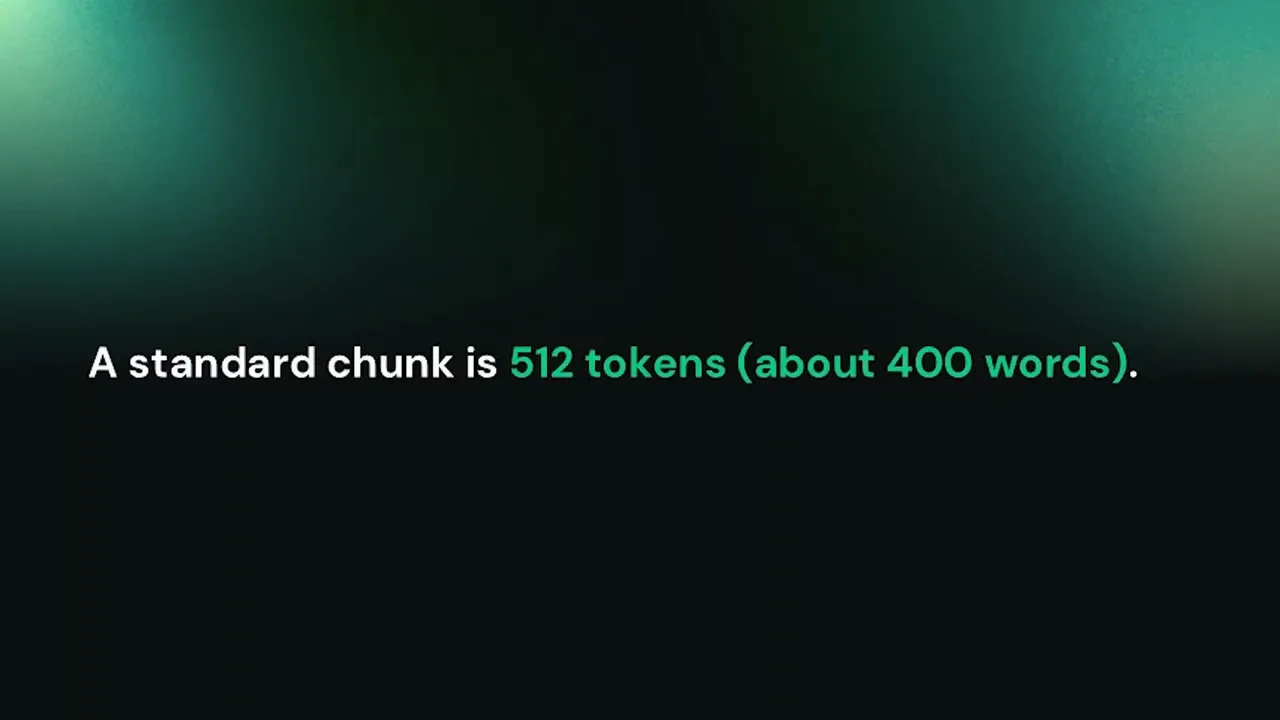
Three ideas do the work. Chunking means you compete passage by passage rather than page by page. Parent document retrieval means the page around the chunk still matters, because the model checks headings and summary sections to confirm the chunk isn't being pulled out of context. And query fan-out means a single prompt becomes many sub-searches, so covering one phrasing is not enough.
The writing advice that follows is unusually testable. Prefer semantic triples, subject-predicate-object, over marketing phrasing: "Apex headphones are waterproof" beats "experience the immersive waterproofness of Apex headphones". Anchor claims to entities a model already knows, so "APAC Search Award-winning agency" outperforms "high-quality SEO agency". And put numbers in.
Instead of talking about having long-lasting battery life, you can talk about having eighteen hours of battery life, because numbers are the natural language that these systems most easily understand.
He attributes a 33.9% GEO improvement from adding statistics to a 2024 Princeton study. I pulled the paper before repeating that number, because a figure carried to three significant figures travels further than it deserves to. It's GEO: Generative Engine Optimization by Aggarwal and colleagues, senior authors at Princeton, and the abstract's headline claim is that GEO methods lift visibility by up to 40%. The 33.9% belongs to one method inside the results table, not to the paper's summary. So: use the tactic, it's well supported. Don't put the decimal in your deck.
His most quotable line is about the discipline war everyone else was busy fighting:
My position on this great SEO civil war is that I simply do not care.
Does digital PR still move AI visibility?
On his numbers, more than anything else he tested. James Norquay founded Prosperity Media and ran the conference, and his talk is the least theoretical in the video: campaign after campaign with links, brand mentions and citation coverage attached.
A data study for Reckon earned 239 links and 537 brand mentions, and he reports around 70% citation coverage for related queries. An Airtasker campaign on the mouldiest cities in Australia produced 25 pieces of coverage and 2,452 brand mentions. A law-firm client sits at 690 links and 570 brand mentions cumulatively, alongside a 125% increase in organic traffic.
Digital PR is a key driver of LLM success at scale.
His best tactical insight is about regional coverage. Everyone runs "Sydney is the best" studies; almost nobody runs "Bendigo is the best" studies, and regional newsrooms receive a handful of pitches a day rather than hundreds. Local politicians then share the result themselves.
He also issues the warning that matters most for anyone tempted to shortcut expertise. UK publishers are now blacklisting sites that supply invented commentators, and Press Gazette has named more than 50 apparently fake experts quoted in the British press. Norquay says he's seen the same practice in Australia, including a sleep-niche site using fabricated doctors.
Put that next to Scholz's argument and the two of them settle the E-E-A-T question between them. If a signal is cheap enough to fake, it stops being a signal, and the enforcement lands on whoever faked it. Real named people with checkable histories is the only version that survives contact with a journalist.
This one isn't abstract for me. Every quote in this post is timestamped to the second because I'd rather you verify me than trust me, and because the alternative is the thing Press Gazette is now publishing lists about. If I ever put words in Kevin Indig's mouth, he can watch the video and find out. That constraint is doing more for my credibility than an author schema block ever has.
Norquay also credits Metehan Yeşilyurt for the query fan-out research the industry is building on, and Moreau independently calls him the person who has "unlocked the most amount of things" in the current research phase. Two speakers, two hours apart, pointing at the same source.
Why are your best product reviews invisible?
Because they render in JavaScript that language models never execute, and almost nobody has checked. Of everything in these 3.5 hours, this is the one I'd go and check before lunch, and it came from Destiny Flaherty, head of SEO at Princess Polly.
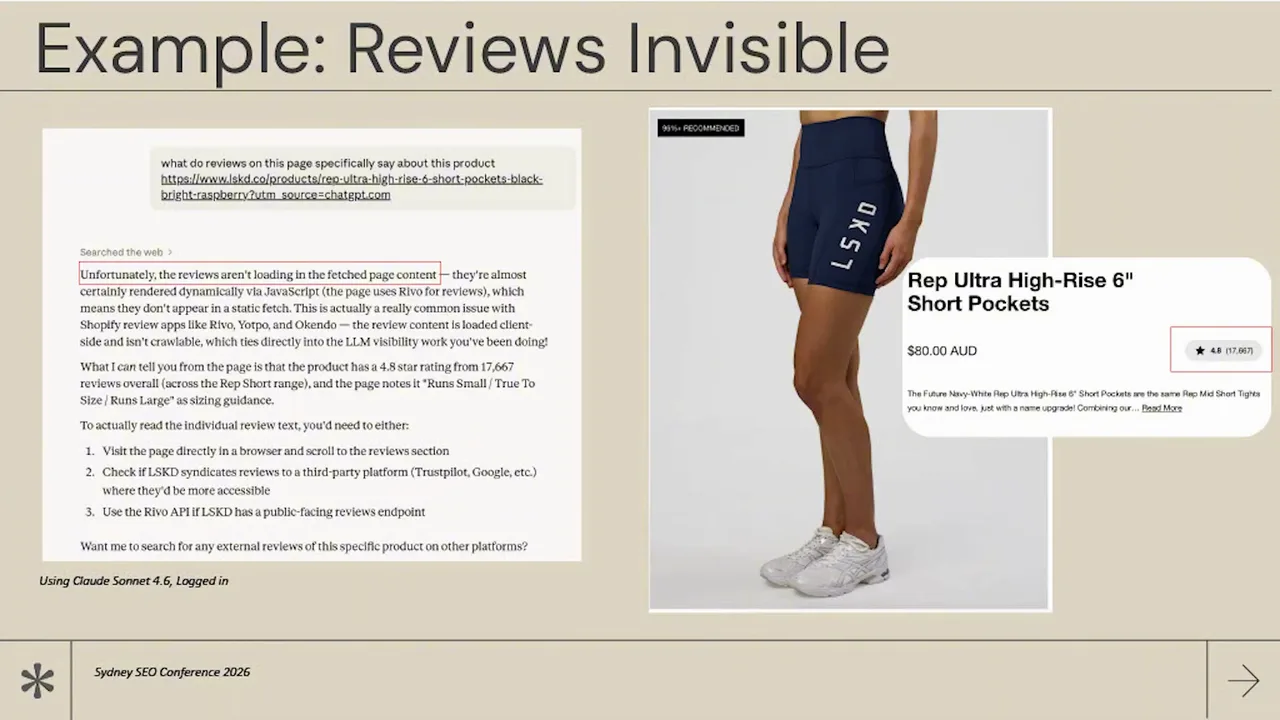
17,000 reviews that talk about how amazing this product is, completely invisible to Google and LLMs.
The consequence is worse than absence. When she asked ChatGPT what a page said about a product, it went and found Reddit commentary claiming the product was poor quality and the sizing was bad, then suggested shopping elsewhere. Her reviews said the opposite and the model never saw them.
Reviews are the only content on an ecommerce site written in the customer's own vocabulary, at volume, for free. Skincare reviews discuss absorption, texture and acne. Those are exactly the long-tail queries a fan-out generates, and no copywriter has to produce them. Flaherty's check takes a minute: view source, search for a review sentence, then confirm your structured data marks up individual written reviews and not just the aggregate rating.
What makes me wince about this one is that it isn't a strategy problem. Nobody decided to hide their best content. A widget was installed, it worked in a browser, everyone moved on, and four years of customer language quietly stopped existing for the systems that now decide what gets recommended. I'd check the review widget on every ecommerce site I touch this month before I'd read another GEO checklist.
Brodie Clark's talk pairs with hers on the feed side. His argument is that Google Merchant Center is the underused half of ecommerce SEO, that Shopping ads documentation quietly governs free listings, and that local inventory feeds unlock surfaces most competitors ignore. His warning is worth repeating: if your in-store stock levels are wrong, Google learns to distrust your inventory and your products start showing as out of stock in rich results.
Is technical SEO dead?
No, but the part that got people hired is. Patrick Stox titled his talk "Technical SEO Is Dead" and then spent it arguing something more specific and more uncomfortable: the entry-level work is gone.
He has standing to say it. He built Patches, Ahrefs' bulk-fix system, and he was clustering keywords with natural language processing in 2016 and writing automated redirect scripts against the Wayback Machine's CDX API in 2015. Asked whether he'd build Patches today, he said no.
Checklist SEOs, you're gonna be replaced. Good SEOs are curious, creative, thinking systems, solve hard problems.
His content example is the one I keep returning to, because it's a precise statement of where the value moved.
85% of every blog says the same thing as what other people said. It's general common knowledge. AI is great for that. It's that extra 15% that matters.
Ahrefs' plan, he says, is to automate the 85% so writers spend their time adding experience and stories to the remaining 15%. What he expects to matter afterwards is taste, opinions and experience, which is the same conclusion Scholz reaches from the brand side and, read plainly, is E-E-A-T described without the acronym.
He makes one prediction I'd bet against: that hallucinations will be largely solved within a year. He names three approaches he's aware of and doesn't detail them. Everything else in his talk is grounded in systems he built with his own hands, and this part isn't. He doesn't pretend otherwise, which is why I trust the rest of it.
The line that stung, and I mean that as a compliment, is the 85/15 split. I've published plenty of pages where the 15% was thinner than I'd like to admit, and the honest test isn't whether AI wrote the draft. It's whether anything in it could only have come from me.
What does this look like for a business without a budget?
It looks like Maid2Match, and it's the talk I'd send to a sceptical founder. Lauren Schwartz runs digital strategy for an Australian residential cleaning company that reached roughly $10 million a year in revenue built almost entirely on organic search, with a paid budget only from 2025, run by her plus five colleagues.
The strategic move was operational, not editorial. When COVID sent 200-plus contractors home, the company rebuilt around permanently employed cleaners rather than subcontractors. That decision is what makes the content unfakeable: real named staff, real photographs, real tenure.
Competitors have ripped off our page layouts, our blog post templates, even our cleaning checklist. But they can't replicate our unique images, our testimonials, our location-specific content about our field staff. If they can just slap their logo on it, then you're doing it wrong.
She flew to Geelong and shot the photos on her iPhone. She asked local staff how residents actually refer to their area and learned that people say "on the Surf Coast", a grouping of suburbs with no postcode and no pin on a map. You cannot generate that from a keyword tool.
Google wants branded search. We want branded search. But you can't get branded search without a damn brand.
Then the quiet heresy. After a full talk on visibility, she mentions AI search almost dismissively, saying she made it an afterthought deliberately because the brand and the SEO foundation are what produce the LLM visibility in the first place. On a stage where seven other speakers had just spent their slots on GEO, that lands harder than it reads.
I think she's earned the right to say it and most people quoting her won't have. A $10 million business on organic with a team of six is the receipt. Without one, "GEO is downstream of brand" is just a reason to postpone the work. She isn't postponing anything: she flew to another city to photograph her own cleaners. That's the version of this I'd defend.
Where the nine experts disagreed
This is the part no summary of this video will give you, and it's why watching all nine talks in order is worth the time. Sitting through them back to back, the contradictions are unmissable.
| Question | One position | The opposing position |
|---|---|---|
| Is GEO its own discipline? | "GEO is just really great SEO" — Destiny Flaherty | Only 12% of AI citations overlap Google's results — Brie Moreau |
| Does freshness deserve weight? | Adding a last-updated date tripled citation rate — Kevin Indig | "New content ranks everything. It doesn't make any sense. It's really stupid" — Brie Moreau |
| Is E-E-A-T a competitive advantage? | A defensive play to not lose position — Jes Scholz | Trust is the first filter users apply, ahead of relevance — Kevin Indig |
| Should GEO be a priority right now? | Deliberately an afterthought behind brand and fundamentals — Lauren Schwartz | The exact playbook to execute now — Destiny Flaherty |
| Is schema useful for language models? | "A lot of people think schema isn't important for LLMs, but it's my opinion that it is" — Destiny Flaherty | Not raised as a lever in the citation research — Brie Moreau |
| What replaces the checklist? | Fame: showmanship, distinctiveness, distribution — Jes Scholz | Taste, opinions and experience — Patrick Stox |
The freshness disagreement is the sharpest, and I don't think either of them is wrong. Indig has client data showing a tripling. Moreau has a two-million-citation dataset and calls freshness scoring nonsensical for evergreen topics. My reading is that a visible date works as a maintenance signal rather than a recency signal, which would explain why it helps on pages where recency itself is irrelevant. That's a guess. Neither of them tested it, neither claimed to, and I'm not going to pretend the video resolved it.
After sitting with all nine, the thing I can't unsee is that the disagreements are tactical and the agreement is structural. Indig's trust stack, Scholz's fame, Norquay's brand mentions, Schwartz's moat, Moreau's co-citation networks, Duignan's online consensus, Flaherty's controlled narrative. Six vocabularies for one idea: be the thing other people reference. None of them coordinated on that, which is why I take it more seriously than any single talk. The 2024 Google API leak that Moreau builds on, which I went through in what the algorithm leaks actually showed, pointed the same way before AI answers arrived.
So my answer on E-E-A-T is not "forget it". It's that the checklist is a floor, and above the floor sits experience nobody else has, numbers nobody else published, and named humans who can be checked. Scholz, Stox and Norquay each say a version of that within ninety minutes of one another, in three registers, without agreeing on much else. That's the closest thing to a finding this video has.
Where I land on SEO and AI search
I've spent this whole post laying out where these nine disagree. Here's where I actually land.
Search is changing. Not ending, changing, and the distinction matters because most of the panic I read online is really grief for a reporting dashboard. The Pew numbers are real and so is Indig's Rift chart. So are the conversions his client kept while losing half their traffic.
Good SEO is still GEO. On the central disagreement in this video I'm with Destiny Flaherty, not with Moreau's 12% overlap. Look at what the nine of them actually recommended: write clearly, structure the page so a machine can lift a passage from it, earn mentions from places that matter, get your reviews rendered in HTML, be worth citing. A competent SEO team already knows how to do every one of those. The label changed. The work mostly didn't. What did change is that the parts we used to treat as optional are now the parts that decide it.
So adopt it now instead of waiting for the industry to agree on a definition. It won't. This video is nine experts failing to agree on one for three and a half hours.
Brand matters more than it did, and that's a shift in my own thinking rather than a position I've always held. Scholz and Schwartz have the better argument: the work you do before anyone searches is now search work, and it belongs in the search budget.
And trust is king. Indig's finding is the one I'd put on the wall. People decide whether they know you before they decide whether you answered them. Everything else in this post is downstream of that.
Frequently asked questions
What is the difference between SEO and GEO?
SEO earns rankings in a list of links. GEO, or generative engine optimization, earns mentions and citations inside an AI-generated answer. The speakers at Sydney SEO Conference 2026 split on whether that difference deserves its own discipline. Destiny Flaherty, head of SEO at Princess Polly, called GEO just really great SEO, while Brie Moreau's citation data shows only a 12% overlap between AI citations and Google's results, which implies the two are further apart than the reassuring version suggests.
Do AI citations overlap with Google rankings?
Much less than most people assume. Brie Moreau cited a study from Josh Blyskal at Profound putting the overlap between AI citations and Google results at 12%, and said his own team's replication landed at 14%. He also found ChatGPT results overlap 26% with Bing, which is why he argues Bing is the more useful proxy. Ranking in Google helps, but it does not automatically buy you AI visibility.
How long should a content chunk be for AI search?
Frank Duignan, who works on GEO at Prosperity Media, said a standard retrieval chunk is 512 tokens, or about 400 words. He advises writing self-contained passages at roughly that length under a clear heading, because language models retrieve chunks rather than whole pages. Parent document retrieval means the surrounding page still matters for context, so headings and key-takeaway sections carry real weight.
Does adding a last updated date improve AI citations?
In one case, dramatically. Kevin Indig showed client data where citation rate tripled after adding a visible last-updated date across a large site's landing pages, alongside genuine content updates. He credits the freshness preference in language models, which lean on live retrieval when a topic sits outside their training data. Brie Moreau was openly sceptical of freshness scoring, calling it stupid for topics where recency is irrelevant.
Is E-E-A-T still worth doing in 2026?
Yes, but not as a differentiator. Jes Scholz argued that E-E-A-T tactics became best practice through collective repetition within the industry echo chamber rather than through testing, and that doing what every competitor does is a defensive play to not lose position. Kevin Indig's user research points the other way: trust is the first filter people apply, ahead of relevance. The honest synthesis is that E-E-A-T is table stakes you cannot skip and cannot win with alone.
Why are my product reviews invisible to ChatGPT?
Because most review widgets render in third-party JavaScript, which language models do not execute. Destiny Flaherty showed a product page with 17,000 reviews that Claude could not read at all, and another where ChatGPT filled the gap with negative Reddit commentary instead. The fix is to render review text in HTML and mark up individual written reviews in structured data, not just the aggregate rating.
Who spoke at Sydney SEO Conference 2026?
The masterclass covers nine talks: Kevin Indig on visibility and trust, James Norquay on digital PR, Lauren Schwartz on local brand building, Jes Scholz on fame over E-E-A-T, Brodie Clark on ecommerce and marketplace SEO, Patrick Stox on the automation of technical SEO, Frank Duignan on how language models work, Destiny Flaherty on ecommerce GEO, and Brie Moreau on what actually gets cited. The event ran on 20 March 2026 in Sydney and was organised by Prosperity Media.
Key takeaways
- Users apply a trust filter before a relevance filter, so brand recognition built before the search is search work even when it produces no attributable clicks.
- Traffic has stopped predicting revenue: Kevin Indig showed a client down 50% in organic traffic year over year while conversions grew almost 20%.
- Most AI visibility reporting is noise. Brie Moreau's two-million-citation analysis found 95% of citations appear once or twice and never return, and only 12% overlap with Google's results.
- Write for retrieval as well as for readers: self-contained passages of roughly 400 words under clear headings, subject-predicate-object phrasing, and specific numbers rather than adjectives.
- Check whether your product reviews exist in HTML. A page with 17,000 reviews that language models cannot read is handing your brand narrative to Reddit.
- E-E-A-T as a checklist is a floor, not an advantage. What sits above the floor is first-hand experience, original numbers, and named people whose track record can be verified.
- Fabricated expertise is now being enforced against. Press Gazette has named more than 50 apparently fake experts, and UK publishers are blacklisting the domains that supply them.
This post is based on FULL 3.5 Hour Masterclass On SEO & GEO Strategies (From Top Experts) by Prosperity Media, recorded at Sydney SEO Conference 2026. Quotes are lightly edited for clarity.